Document Checklist for the Immigration Office (Expats) in Germany
- § 21 / § 16f / § 36 permit: Care Expatriate from €58/month (HanseMerkur · German + English certificate · up to 5 years)
- § 18a employed under JAEG €77,400: DAK ~17.8% of gross (statutory · § 5 Abs. 1 Nr. 1 SGB V · employer pays half)
- Short bridge before the appointment: Care Economy from €30/30 days (Schengen-conform · cancellable when the long-term lane starts)
Three rules that prevent every refusal at the Ausländerbehörde:
- 1Insurance covers the entire requested permit duration: Use Care Expatriate from €58/month (up to 5 years) (private side, up to 5 years) or a DAK 17.8% of gross (open-ended) Mitgliedsbescheinigung (statutory side).
- 2Anmeldung address must match the application: Bürgeramt registration within 14 days of moving in (§ 17 BMG). Even a missing apartment number triggers a refusal at the appointment.
- 3Bridge any gap before the appointment: Care Economy from €30 / 30 days (up to 2 years) Schengen-conform — cancellable monthly the day the long-term lane starts.
Appointment booked? 30-second permit-document tariff finder →
Inside: the one document the Ausländerbehörde refuses 1 in 3 of the time · why a 12-month policy quietly shortens a 3-year permit request · the bridge tariff that costs less than one inpatient day (~€830)
Sources: § 5 Abs. 1 Nr. 1 AufenthG (cover precondition) · § 16b / § 16f / § 18a / § 21 / § 36 AufenthG (permit categories) · § 17 BMG (Anmeldung deadline) · § 5 Abs. 1 Nr. 1 SGB V (statutory employees) · § 6 Abs. 6 SGB V (JAEG €77,400 in 2025) · DAK-Gesundheit tariff sheet 2026 · HanseMerkur Care Expatriate / Care Economy AVB · Statistisches Bundesamt DRG 2024
Long-Stay Coverage
Care Expatriate by HanseMerkur Versicherungsgruppe / Advigon
Residence Documents
Proof for visa or immigration authority documents
Fast Confirmation
PDF confirmation available after successful application
Over 10,000 policies issued · Since 2009
Ausländerbehörde appointment ahead? Lock in the recognised insurance certificate this week — Care Expatriate from €58/month for § 21 / § 16f / § 36, DAK Mitgliedsbescheinigung for § 18a employed under JAEG, Care Economy from €30/30 days as the short bridge.
8 documents to bring to the German Ausländerbehörde — full checklist
Quick answer: "What documents do I need to bring to my residence-permit appointment in Germany?" — these eight items cover every standard permit category (§ 16b Study, § 16f Job-search, § 18a Skilled Worker, § 21 Self-employed, § 36 Family). The insurance certificate (item 7) is the single most common reason for refusal — bring a recognised long-term proof, never a travel-only or Schengen-only policy.
Valid passportOriginal + copy of the data page
Must be valid for at least 3 months beyond the requested permit duration. Bring the original AND a clear copy of the data page (and any prior German visa pages).
Current entry visa or prior residence permitOriginal (in passport)
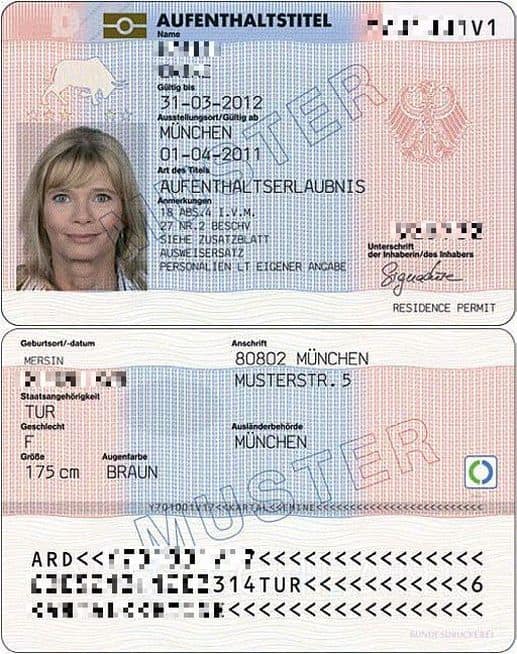
If you entered on a national D-visa, the eAT (electronic residence permit) replaces it on first appointment. If you already hold an eAT, bring the card itself.
Biometric passport photo1 photo, ICAO biometric (35 × 45 mm)
Recent (within 6 months), neutral background, frontal pose. Most Bürgerbüros and Fotofix booths inside the Ausländerbehörde provide compliant photos for €5–10.
Residence-permit application formSigned Antrag auf Erteilung / Verlängerung
Download from your local Ausländerbehörde website (typically a 4–6 page PDF). Fill in completely; the office no longer accepts handwritten partial forms in many cities (e.g. Berlin, Munich, Hamburg).
Anmeldung confirmation (Meldebescheinigung)Original, issued by the Bürgeramt
Mandatory under § 17 BMG within 14 days of moving in. The Ausländerbehörde will not process the permit without it. The address must match the one on the application form.
Proof of income or financingWork contract / freelance contracts / Sperrkonto / Verpflichtungserklärung
§ 18a Skilled Worker → signed work contract (with salary stated). § 21 Self-employed → freelance contracts and business plan. § 16b Study → Sperrkonto certificate (€11,904 in 2025) or Verpflichtungserklärung. § 16f Job-search → bank-account proof for 18 months of living costs.
Recognised health-insurance certificateLong-term cover for the entire requested permit duration
Mandatory under § 5 Abs. 1 Nr. 1 AufenthG. § 18a employed under JAEG (€77,400 in 2025) → DAK Mitgliedsbescheinigung (~17.8% of gross). § 21 / § 16f → Care Expatriate from €58/month (HanseMerkur, recognised, German + English certificate). Travel-only and Schengen-only policies are routinely refused as long-term proof.
Appointment confirmation + fee (€100)Bring your Termin-PDF and €100 cash / EC card
First-issue residence permit fee: €100 (€56 for renewals). Many offices only accept EC card, no credit cards. Keep the receipt — it is needed if you collect the eAT card 4–6 weeks later.
Avoid the mistakes that can delay your application
Visitor insurance may be too short
For multi-month or multi-year stays, Care Expatriate can be a better fit than short visitor coverage.
Statutory or private?
Freelancers, self-employed people and some incoming long-stay cases may need private incoming coverage instead of German statutory insurance.
Residence proof requested?
Care Expatriate can provide PDF confirmation after successful application for visa or immigration documents.
Renewal stress later
A longer coverage term can reduce repeated renewal pressure during projects, residence processes or long stays.
What missing or wrong insurance proof at the appointment can cost
One wrong insurance choice can cost you money, time and your application deadline
A medical incident can become expensive fast — but the wrong certificate can also delay your visa, enrollment, residence permit or work start.
🏥
€500–€1,500
Emergency doctor visit
One urgent doctor or emergency-room visit can already create a painful bill — before tests, medication or follow-up treatment are added.
🏨
€2,000–€10,000+
Hospital treatment
If observation, surgery, overnight stay or specialist treatment is needed, costs can quickly move from hundreds to thousands of euros.
🧳
Up to 5 years
Short visitor cover may be too weak
For long stays, freelance work or residence documents, short visitor insurance may be too short or not the right proof.
- Wrong or incomplete proof can delay your visa, enrollment or authority process.
- Cheap home-country policies may miss the exact coverage, dates or repatriation wording required.
- The cheapest policy can become expensive if it is the wrong proof for your situation.
Before you apply, check: coverage amount, validity dates, destination area and repatriation cover.
Appointment in the next weeks? Order the long-term certificate today — the Ausländerbehörde checks every page on the spot
Why act before your residence documents are due
Long-stay proof can become urgent during visa, residence permit, project or relocation steps. Short visitor cover may not be enough.
Long stay, different proof
Care Expatriate can fit longer incoming stays up to 5 years, depending on age and selected plan.
Residence documents need clarity
Your proof should match destination, coverage period and long-stay purpose.
Do not wait for renewal stress
Preparing longer coverage early can reduce repeated extension pressure.
Private or statutory?
Freelancers, self-employed people and employees on assignment without German statutory insurance may need a different route than employees.
From document list to recognised certificate — in 3 steps
10 minutes online for Care Expatriate (long-term, § 21 / § 16f / § 36) or Care Economy (short bridge), the certificate is issued by email in German + English within 24 hours and is accepted by every Ausländerbehörde for the appointment. For § 18a employed under the JAEG, request the DAK Mitgliedsbescheinigung directly from your Krankenkasse the day the contract is signed.
Long-term stay covered in 3 steps
Care Expatriate can cover longer incoming stays up to 5 years, depending on age and selected plan.
-
Choose your plan
Care Expatriate for expats, freelancers, self-employed people, employees on assignment without German statutory insurance, or seniors up to entry age 74.
-
Complete the application
Enter passport, destination, stay details and requested coverage period online. Additional questions may apply depending on the plan.
-
Submit your proof
Receive PDF confirmation after successful application and submit it to the embassy, consulate or immigration authority if requested.
What expats say about Care Expatriate as recognised proof for the Ausländerbehörde
“My biggest worry was that the embassy wouldn't accept the insurance.
The proof was accepted immediately — no questions asked.
That saved me a lot of stress.”

Georges
Cameroon
“I needed proof of insurance urgently for my visa appointment.
The confirmation arrived within minutes by email.
Everything worked first time at the embassy.”

Olga
Russia
“Found the best solution and best service for health insurance for foreign visitors and guests in Germany.
Fast, simple and affordable.
Highly recommended!”

Michael
Germany
“The online sign-up was done in just a few minutes.
When I actually had to see a doctor, the billing went smoothly.
I was really covered — not just on paper.”

Yunhee
Australia
Now choose your plan
The 3 recognised insurance products for the Ausländerbehörde
Care Expatriate
from only €58.00 / month (coverage up to 5 years)
For foreign nationals with longer stays: expats, self-employed professionals, freelancers, employees on assignment without German statutory insurance, retirees & seniors up to age 74
- Proof of insurance for visas & immigration authorities quickly available (PDF)
- Coverage up to 5 years – less renewal stress
- Doctor, hospital, prescription medication & dental treatment coverage
- For longer stays in Germany, Austria, the EU/Schengen Area, Liechtenstein or Switzerland
- Suitable for expats, self-employed professionals, freelancers, employees on assignment without German statutory insurance, retirees & seniors
- More planning security for residence permits, projects or jobs
- 24/7 assistance + digital insurance card
- Age-based rates: from €58/month ages 13–40 · from €68 ages 41–60 · from €246 ages 61–74
- Coverage term: 3 months to 5 years · entry age 0–74
- Reputable insurance carrier
Why Care Expatriate?
For foreign nationals with longer stays who need solid health insurance and proof of coverage for authorities — suitable for expats, freelancers, self-employed professionals, employees on assignment without German statutory insurance, retirees & seniors up to age 74.
Why a 5-year coverage term?
More planning security: less renewal stress and a lower risk of a coverage gap if your stay lasts longer.
- 🏛️ HanseMerkur Insurance Group Hamburg – Advigon Insurance AG
- 📄 Instant proof of insurance for visas & immigration authorities (PDF)
- 🔒 Doctor, clinic, dental treatment & repatriation coverage
- 🏷️ From €58 / month · coverage up to 5 years
→ Complete the application, receive your instant PDF, submit your proof
DAK-Gesundheit Employees
currently 17.8% of gross income
(employer pays half · plus long-term care insurance)
For foreign employees with a social-security-covered job in Germany
- Statutory health insurance for employees in Germany
- Employer pays half of the health insurance contribution
- Family coverage for spouse & children may be possible under statutory rules
- Doctor, dentist, hospital, pharmacy & prescription medication coverage
- Health insurance card for medical treatment in Germany
- EU/EEA coverage via the European Health Insurance Card
- Save €120 per year with DAK Garantietarif 120 possible
- Optional: DAK Fit & Travel with additional benefits up to age 39
- Mandatory long-term care insurance also applies
- Reputable statutory health insurance provider
Why DAK-Gesundheit?
For foreign employees in Germany who need statutory health insurance with a health insurance card, employer contribution and possible family coverage.
Why statutory health insurance as an employee?
More security in everyday working life in Germany: the employer pays half, family members may be covered free of charge under certain conditions, and medical treatment is handled easily through the health insurance card.
- 🏛️ DAK-Gesundheit
- 📄 Membership certificate for employers & authorities
- 🔒 Doctor, dentist, clinic, pharmacy & prescription medication
- 🏷️ Currently 17.8% of gross income · employer pays half
→ Complete the application, start your membership, receive your health insurance card
Care Economy
from only €30.00 / 30 days (coverage up to 2 years)
For guests, tourists, family visits, job seekers & the German Opportunity Card
- Proof of insurance for visas & immigration authorities within minutes
- Affordable coverage from €1.00 per day
- Doctor, hospital & dental emergency coverage
- Suitable for Schengen visas, the Opportunity Card & family visits
- Flexible coverage from 1 day up to 2 years
- Coverage in Germany, the EU & the Schengen Area
- 24/7 assistance + digital insurance card
- Age-based rates: from €1.00/day up to age 64 · from €2.95/day for ages 65–74
- Coverage term: 1 day to 2 years · entry age 0–74
- Reputable insurance carrier
Why Care Economy?
For anyone who needs fast, affordable proof of health insurance — ideal for guests, visitors, tourists, family visits or job seekers, with doctor/clinic coverage subject to the policy terms and benefits.
Why a 2-year coverage term?
More flexibility when plans are uncertain: if your visa, trip or stay is extended, you avoid last-minute renewal stress and reduce the risk of a coverage gap.
- 🏛️ HanseMerkur Insurance Group Hamburg – Advigon Insurance AG
- 📄 Instant proof of insurance for visas & immigration authorities (PDF)
- 🔒 Doctor, clinic, dental emergency & repatriation coverage
- 🏷️ From €30 / 30 days · up to 2 years possible
→ Complete the application, receive your instant PDF, submit your proof
Need the residence-permit explainer? Why insurance is almost always required. First job day 1? HR insurance-proof checklist. Coming from a student visa? Student → first job. Searching for a new job? Job-search lane. Switching residence permits? Transition matrix. Self-employed vs employed? Lane comparison. Compare every expat lane in the foreigners hub.
Full price tables — Care Expatriate · DAK-Gesundheit · Care Economy
Quick answer: Three recognised products cover every Ausländerbehörde permit category: Care Expatriate from €58/month for the private side (§ 21 / § 16f / § 36), statutory DAK at ~17.8% of gross under the JAEG for § 18a employed, and Care Economy from €30/30 days as the universal short bridge before the appointment.
§ 21 / § 16f / § 36 permit — Care Expatriate
HanseMerkur incoming, ages 0–74, up to 5 years, accepted by every Ausländerbehörde for the private-side permit categories, certificate issued in German + English (3 tiers — Basic / Comfort / Premium):
| Care Expatriateworldwide without USA, Canada and Mexico |
Basic
|
BestsellerComfort
|
Premium
|
|||
|---|---|---|---|---|---|---|
|
Deductible / yr
150,–
|
Deductible / yr
150,–
|
Deductible / yr
500,–
|
Deductible / yr
0,–
|
Deductible / yr
500,–
|
Deductible / yr
1.000,–
|
|
| Entry age:0–12 (€ / month) | 64,– | 104,– | 81,– | 191,– | 149,– | 117,– |
| Entry age:13–40 (€ / month) | 58,– | 84,– | 63,– | 181,– | 141,– | 109,– |
| Entry age:41–60 (€ / month) | 68,– | 103,– | 77,– | 256,– | 201,– | 156,– |
| Entry age:61–74 (€ / month) | 246,– | 322,– | 248,– | 432,– | 336,– | 263,– |
All prices per month/person in euros. Deductible applies per insurance year. As of 2026.
§ 18a employed under JAEG — DAK-Gesundheit
Statutory under § 5 Abs. 1 Nr. 1 SGB V, ~17.8% of gross salary, employer pays half, free Familienversicherung for spouse and children (DAK button price: 17.8% of gross (open-ended)):
| DAK-Gesundheit for employees (statutory) | |
|---|---|
| General contribution rate |
14.6 % of gross
+ 3.2 % DAK supplement = 17.8 %
|
| Employer / employee share |
8.9 % each
Paid 50/50
|
| Compulsory long-term care |
approx. 3.6 % standard
4.2 % childless from age 23 · reductions depending on number of children
|
| Total (incl. care, childless) |
≈ 22.0 % of gross
Depending on long-term care variant
|
| Family co-insurance |
possible
Spouse & children covered under statutory conditions
|
| Sickness pay (Krankengeld) |
from day 43
70 % of gross, max 78 weeks
|
| Compulsory insurance limit (JAEG) |
€77,400 / year
= €6,450 / month (as of 2026)
|
2026 contribution rates: 14.6 % general + 3.2 % DAK supplement = 17.8 %; split 50/50 between employer and employee (8.9 % each). Compulsory long-term care approx. 3.6 % standard, 4.2 % childless from age 23, reductions depending on number of children. Family co-insurance possible under statutory conditions. As of 2026.
Short bridge — Care Economy
Schengen-conform incoming, ages 0–74, 1 day to 2 years, cancellable the day the long-term lane (DAK or Care Expatriate) is in place:
| Care Economy Duration |
Bestsellerup to 64
|
up to 64
|
Bestseller65+
|
65+
|
|---|---|---|---|---|
| no deductible | with deductible | no deductible | with deductible | |
| up to 90 days | €1.18/day | €1.00/day | €3.48/day | €2.95/day |
| 91–180 days | €1.59/day | €1.35/day | €4.37/day | €3.70/day |
| 181–365 days | €2.30/day | €1.95/day | €5.84/day | €4.95/day |
| 366–730 days | €2.83/day | €2.40/day | €9.32/day | €7.90/day |
All prices per day/person in euros. Minimum premium €10 per person and term. Deductible is the share you pay yourself. Entry age 0–74. As of 2026.
How long should the health insurance run?
Quick answer: Usually for as long as the stay is planned to last — and not shorter. The premium is set by the entry age at the start of the contract and stays in that age band for the whole term. Anyone who extends later typically signs a new contract at the age they are by then.
| Term | Premium/month | Total | Renewals needed | Pre-existing-condition gap |
|---|---|---|---|---|
| 12 months | €58 | €696 | 4 | possible (2×) |
| 24 months | €58 | €1,392 | 2 | possible (1×) |
| 60 months | €58 | €3,480 | 0 | none |
Is a 41st birthday coming up?
In the 13–40 age band the Basic premium is €58/month; in the 41–60 band it is €68/month (example values). The difference is around €10 a month — roughly €600 over 60 months. What counts is the age at the start of the contract, not the age during the term. Concretely: someone who chooses a 60-month term at 40 pays the 13–40 band for five years, rather than the 41–60 band from their 41st birthday onwards.
When the renewal falls due
A policy with a twelve-month term typically expires at close to the point the residence permit (Aufenthaltstitel) also needs extending. Both then fall in the same weeks: new contract, new proof of cover, new appointment at the foreigners' authority (Ausländerbehörde) — often under time pressure. A longer term decouples the two dates. There is also the practical effort: every renewal means passport details, proof of address and personal information again — usually gathered by relatives in Germany while the insured person is still abroad.
What is different at renewal
Conditions that first arise during a running contract are, as a rule, covered within that contract. In a contract taken out later they typically count as a pre-existing condition — and pre-existing conditions are usually excluded in incoming tariffs. The older the insured person, the more likely it is that a diagnosis falls between two contracts, and that diagnosis then usually counts as pre-existing in the follow-up contract. A continuous term avoids that gap.
A gap can also open up between two contracts — days without cover, which may become visible when the residence permit is next extended. A continuous term avoids that.
A fixed term also means planning certainty for the family: the premium is set for the whole duration, with no annual recalculation.
For context: Care Expatriate can be taken out up to the age of 74.
Monthly or a single payment?
Quick answer: Both are possible, and the price is the same — there is no discount for paying in one go. The difference lies in the risk: if a direct debit goes unpaid, that can affect the insurance cover — and the residence permit rests on that cover. With a single payment the cover no longer depends on an ongoing bank debit. That matters above all where the premiums are paid by relatives in Germany: a job change, a change of bank or one tight month then has no bearing on the insured person's residence status.
Where the premium is transferred from abroad, one payment replaces up to sixty individual transfers — each with its own bank charges and exchange rate.
What happens on an early return?
If the stay ends earlier than planned, the contract can be cancelled in writing. The overpaid premium is, as a rule, refunded minus a €5 processing fee (source: Care Concept FAQ). So someone who pays 60 months in advance and returns after two years gets the premium for the unused months back — the financial risk of paying in one go is therefore €5, not the remaining balance.
And if the visa is not granted?
If the entry visa is not granted, or entry does not take place for other reasons, the application can be cancelled in writing before the insurance cover begins. Premiums already paid are, as a rule, refunded minus a €5 processing fee (source: Care Concept FAQ).
FAQ — Document checklist for the German Ausländerbehörde
Frequently Asked Questions
Which documents does the Ausländerbehörde request from expats in Germany?
Passport, biometric photo, Anmeldebestätigung (Bürgeramt), insurance certificate (Care Expatriate from €58/month or DAK-Gesundheit at 17.8% of gross), employment/freelance contract, and proof of income — all required under § 5 AufenthG for the residence permit.
What's the deadline for submitting insurance proof to the immigration office?
Usually 2–4 weeks after appointment or on the Fiktionsbescheinigung due date. Care Expatriate issues the § 5 AufenthG certificate as a PDF the same day — safer than waiting for DAK-Gesundheit's Mitgliedsbescheinigung which takes 3–5 working days.
Is a scanned insurance certificate accepted by the German immigration office?
Most Ausländerbehörden accept PDFs uploaded via the online portal. Care Expatriate and DAK-Gesundheit both issue digitally signed certificates. Berlin, Munich and Frankfurt request the original at the counter appointment only.
What happens if I submit insurance proof late to the German immigration office?
Bridging with Care Expatriate from €58/month (same-day PDF) or Care Economy from €30/30 days keeps the § 5 AufenthG chain intact. The residence permit is either refused, delayed, or issued as a short Fiktionsbescheinigung with a resubmission deadline.
Which tariffs does the Ausländerbehörde accept for expat residence permits?
Care Expatriate (private, from €58/month), Care Economy (short-term bridge from €30/30 days), Care Visa Protect (from €0.85/day for entry) and DAK-Gesundheit (17.8% of gross, GKV). All four are recognized under § 5 AufenthG and carry the required certificate wording.
What documents do I need for the immigration office in Germany?
Typically: valid passport, health insurance proof, employment contract, registration certificate (Meldebescheinigung), income proof, biometric photos, and rental agreement. Care Expatriate provides instant PDF proof designed to satisfy § 5 AufenthG. See also our Expat Document Check tool.
How do I get health insurance proof for the Ausländerbehörde quickly?
With Care Expatriate (from €58/month), you receive your insurance certificate as a PDF immediately after enrollment – no waiting time, accepted for all residence permit types.