Costs and benefits — what do foreigners really pay for health insurance in Germany?
By Steffan Grund · Reviewed
"Switched from a home-country travel policy to Care Expatriate at €58/month — Ausländerbehörde Berlin accepted the file on the spot." — A. M. (Cairo → Berlin), freelancer
Quotes from internal customer feedback, anonymised and shortened.
Plan: identify your status (employee / self-employed / student / newcomer) → compare GKV, substitutive PKV and Incoming on the same three line items (premium, deductible, benefits scope) → pick the recognised certificate the Ausländerbehörde expects under § 5 AufenthG.
Used by foreigners arriving in Germany from — show country list
Pakistan (Islamabad, Karachi, Lahore), India (Delhi, Mumbai, Bengaluru, Hyderabad, Chennai), Bangladesh, Sri Lanka, Nepal, Türkiye, Iran, Iraq, Syria, Lebanon, Egypt, Morocco, Tunisia, Algeria, Nigeria, Ghana, Kenya, Ethiopia, the Philippines, Indonesia, Vietnam, Thailand, China, Brazil, Colombia, Mexico, Ukraine, Russia, Kosovo, Serbia, Bosnia, North Macedonia and Albania.
Used since 2009 by foreigners arriving in Germany — typically accepted by the Ausländerbehörde, the German embassies and the universities for the Krankenversicherungsnachweis. Individual case review applies.
No commitment · monthly cancellation · confirmation by email (typically immediate).
Sources: § 5 AufenthG · § 62 SGB V · § 175 SGB V · § 203 VVG · GKV-Spitzenverband · DKG hospital statistics 2024 · HanseMerkur AVB · Care Concept AG
Frequently used by foreigners from — show country list
Pakistan (Islamabad, Karachi, Lahore), India (Delhi, Mumbai, Bengaluru, Hyderabad, Chennai), Bangladesh, Sri Lanka, Nepal, Türkiye, Iran, Iraq, Syria, Lebanon, Egypt, Morocco, Tunisia, Algeria, Nigeria, Ghana, Kenya, Ethiopia, the Philippines, Indonesia, Vietnam, Thailand, China, Brazil, Colombia, Mexico, Ukraine, Russia, Kosovo, Serbia, Bosnia, North Macedonia and Albania.
Used since 2009 by foreigners arriving in Germany — typically accepted by the Ausländerbehörde and the German embassies under § 5 AufenthG. Individual case review applies.
General information based on the Aufenthaltsgesetz (AufenthG), the Sozialgesetzbuch V (SGB V), the Versicherungsvertragsgesetz (VVG) and our placements since 2009 — not legal, tax or insurance advice; individual embassy, Krankenkasse and Ausländerbehörde caseworkers may decide case-by-case.
Indicative: a single uninsured inpatient week in Germany averages roughly €4,000–€4,500 at the DRG day-rate of about €830/day (DKG, 2024). Care Expatriate from €58/month at ages 13–40 covers the same window. Individual case review applies; not medical or financial advice.
Three price logics, one recognised certificate. What foreigners pay in Germany depends on legal status: employees under the JAEG threshold (€77,400/year, 2026) are bound to GKV (~14.6% + Zusatzbeitrag, split with the employer); employees above the JAEG, civil servants and most self-employed residents may opt for substitutive PKV (€350–€900/month, medically underwritten); newcomers, freelancers in the first months, language students and Studienkolleg attendees use Incoming insurance with a fixed age-banded monthly premium.
The recognised price floors for the Ausländerbehörde are Care College from €27.50/month for language and Studienkolleg students up to age 29, and Care Expatriate from €58/month for the general adult cohort. For Schengen short visits the day-rate option is Care Visa Protect from €0.85/day. Once GKV access opens (employment, matriculation), the file usually moves to DAK-Gesundheit or another sickness fund.
Below: how German co-payments and deductibles actually work, the four cost mistakes we still see weekly, the price tables for Care Expatriate and Care College, the deep guides for every cost & benefit question and the questions foreigners ask the most.
Editor's note: since 2009 we have issued bilingual insurance certificates for residence-permit files in Berlin, Hamburg, Munich, Frankfurt, Cologne, Hannover, Stuttgart, Düsseldorf and Leipzig. The two cost mistakes we still see weekly are (1) a home-country travel policy used instead of an Incoming product — saved on paper, lost at the counter; and (2) PKV chosen above the JAEG threshold without modelling the age curve to retirement. Both are avoidable with five minutes of modelling on the tables below. Last reviewed by Steffan Grund on August 27, 2026.
Trusted Providers
Care Concept · HanseMerkur · DAK-Gesundheit · BASTI
Proof for Your Situation
Visa, enrollment, residence, employer or blocked-account documents
Online Process
Apply online and receive the available confirmation after successful completion
What counts as ‘cost’ and ‘benefit’ for foreigners in Germany
Quick answer: The visible cost is the monthly premium. The hidden cost is the annual deductible, the per-prescription Zuzahlung, the hospital day fee and the dental gap. The benefit side is what the Krankenkasse, the PKV insurer or the Incoming carrier actually pays for an inpatient stay, a specialist visit or a repatriation. For the residence permit, the single document that matters is the bilingual Krankenversicherungsnachweis — caseworker discretion applies.
Foreigners in Germany meet up to three different cost systems in the same year: GKV percentage-of-salary, substitutive PKV age-and-health-based and Incoming age-banded flat monthly. The benefit side runs on a single statutory catalogue for GKV (G-BA directives) and on per-product AVB for PKV and Incoming. What the Ausländerbehörde verifies is not the premium but the policy summary — see § 5 AufenthG for the official source.
Note on terminology: the German word «Krankenversicherungsnachweis» covers every recognised certificate — the GKV Mitgliedsbescheinigung, the substitutive PKV policy or the Incoming bilingual PDF. All three are accepted; what differs is how each one is priced and what it covers.
Over 10,000 policies issued · Since 2009
Need an Ausländerbehörde-ready certificate today?
The 4 most common cost mistakes — and how each one is solved
Quick answer: Four cost decisions repeat at almost every foreigner's first year in Germany: home-country travel policy in place of Incoming, the wrong product family for the legal status, an over-priced PKV chosen above JAEG without modelling the age curve, and a Zusatzbeitrag rise missed on a comparable GKV fund.
Travel policy used in place of Incoming
Home-country travel insurance typically fails § 5 AufenthG — wrong validity area, wrong duration, missing repatriation.
Care Expatriate clears § 5 AufenthG →Wrong product family for the legal status
Substitutive PKV signed above JAEG without modelling the ageing premium — locked in for years.
Care Expatriate as the bridge while you decide →Zusatzbeitrag rise missed
A 0.4% Zusatzbeitrag rise on a €5,000/month salary is €20 more every month — and triggers a 2-month special right of cancellation under § 175 SGB V.
See how DAK compares →Deductible chosen blind
A €600 PKV deductible saves €15/month — but costs €600 the first year you actually use the doctor. Model expected utilisation first.
Care Expatriate tiers compared →Reality check: what a single uninsured incident actually costs
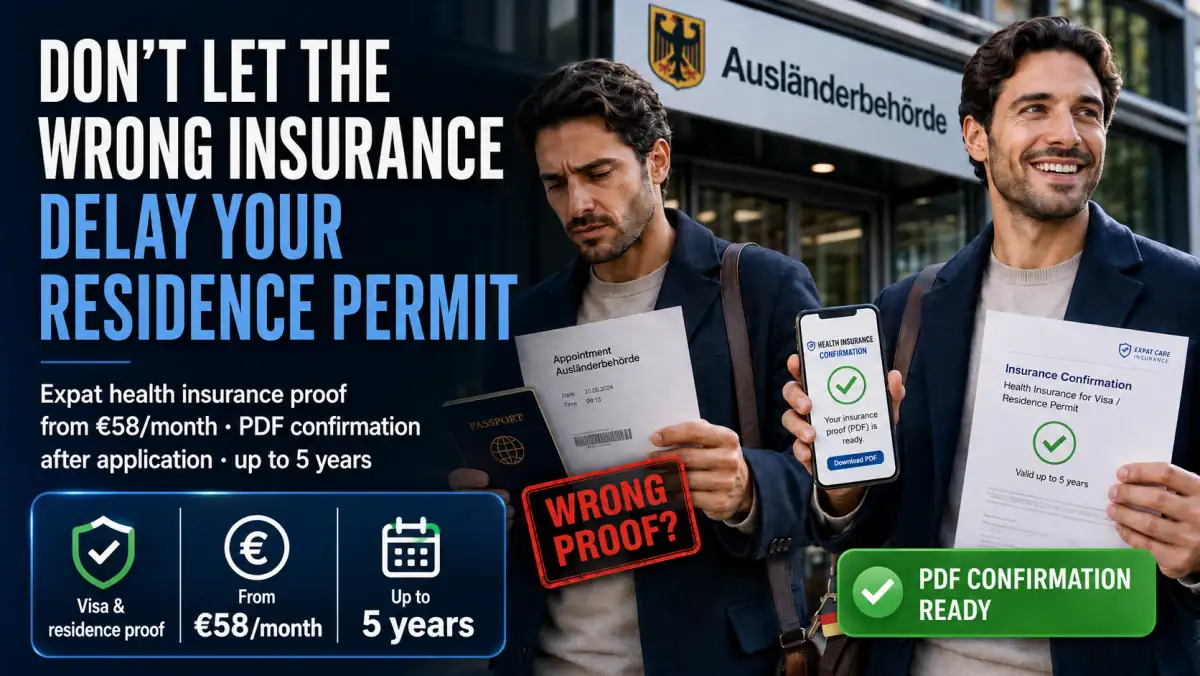
One wrong insurance choice can cost you money, time and your application deadline
A medical incident can become expensive fast — but the wrong certificate can also delay your visa, enrollment, residence permit or work start.
🏥
€500–€1,500
Emergency doctor visit
One urgent doctor or emergency-room visit can already create a painful bill — before tests, medication or follow-up treatment are added.
🏨
€2,000–€10,000+
Hospital treatment
If observation, surgery, overnight stay or specialist treatment is needed, costs can quickly move from hundreds to thousands of euros.
🧳
Up to 5 years
Short visitor cover may be too weak
For long stays, freelance work or residence documents, short visitor insurance may be too short or not the right proof.
- Wrong or incomplete proof can delay your visa, enrollment or authority process.
- Cheap home-country policies may miss the exact coverage, dates or repatriation wording required.
- The cheapest policy can become expensive if it is the wrong proof for your situation.
Before you apply, check: coverage amount, validity dates, destination area and repatriation cover.
Why the timing of the switch decides the year-end total
Why act before your residence documents are due
Long-stay proof can become urgent during visa, residence permit, project or relocation steps. Short visitor cover may not be enough.
Long stay, different proof
Care Expatriate can fit longer incoming stays up to 5 years, depending on age and selected plan.
Residence documents need clarity
Your proof should match destination, coverage period and long-stay purpose.
Do not wait for renewal stress
Preparing longer coverage early can reduce repeated extension pressure.
Private or statutory?
Freelancers, self-employed people and employees on assignment without German statutory insurance may need a different route than employees.
What foreigners say about Care Expatriate, Care College and the Ausländerbehörde-ready certificate
“My biggest worry was that the embassy wouldn't accept the insurance.
The proof was accepted immediately — no questions asked.
That saved me a lot of stress.”

Georges
Cameroon
“I needed proof of insurance urgently for my visa appointment.
The confirmation arrived within minutes by email.
Everything worked first time at the embassy.”

Olga
Russia
“Found the best solution and best service for health insurance for foreign visitors and guests in Germany.
Fast, simple and affordable.
Highly recommended!”

Michael
Germany
“The online sign-up was done in just a few minutes.
When I actually had to see a doctor, the billing went smoothly.
I was really covered — not just on paper.”

Yunhee
Australia
Now choose your plan
Recommended health insurance by price anchor
Two recognised Incoming products cover the broad cost spectrum for foreigners in Germany — Care Expatriate as the general adult anchor (€58/month from age 13), Care College as the language-student price floor (€27.50/month). Both ship the bilingual Krankenversicherungsnachweis the Ausländerbehörde verifies.
Care Expatriate
from only €58.00 / month (coverage up to 5 years)
For foreign nationals with longer stays: expats, self-employed professionals, freelancers, employees on assignment without German statutory insurance, retirees & seniors up to age 74
- Proof of insurance for visas & immigration authorities quickly available (PDF)
- Coverage up to 5 years – less renewal stress
- Doctor, hospital, prescription medication & dental treatment coverage
- For longer stays in Germany, Austria, the EU/Schengen Area, Liechtenstein or Switzerland
- Suitable for expats, self-employed professionals, freelancers, employees on assignment without German statutory insurance, retirees & seniors
- More planning security for residence permits, projects or jobs
- 24/7 assistance + digital insurance card
- Age-based rates: from €58/month ages 13–40 · from €68 ages 41–60 · from €246 ages 61–74
- Coverage term: 3 months to 5 years · entry age 0–74
- Reputable insurance carrier
Why Care Expatriate?
For foreign nationals with longer stays who need solid health insurance and proof of coverage for authorities — suitable for expats, freelancers, self-employed professionals, employees on assignment without German statutory insurance, retirees & seniors up to age 74.
Why a 5-year coverage term?
More planning security: less renewal stress and a lower risk of a coverage gap if your stay lasts longer.
- 🏛️ HanseMerkur Insurance Group Hamburg – Advigon Insurance AG
- 📄 Instant proof of insurance for visas & immigration authorities (PDF)
- 🔒 Doctor, clinic, dental treatment & repatriation coverage
- 🏷️ From €58 / month · coverage up to 5 years
→ Complete the application, receive your instant PDF, submit your proof
Care College
from only €27.50 / month (coverage up to 5 years)
For language schools, Studienkolleg, DSH, continuing education, visiting researchers & educational stays
- Proof of insurance for visas & immigration authorities quickly available (PDF)
- Affordable health insurance from €27.50 / month
- Doctor, hospital, prescription medication & dental treatment coverage
- For educational stays in Germany or the EU/Schengen Area — except Austria
- Suitable for language students, Studienkolleg, DSH, continuing education & visiting researchers
- Coverage up to 5 years – less renewal stress
- 3 plan levels available: Basic, Comfort & Premium
- 24/7 assistance + digital insurance card
- Coverage term: 1 month to 5 years · entry age up to 40
- Reputable insurance carrier
Why Care College?
For foreign nationals with an educational stay who need affordable health insurance and proof of coverage for authorities — suitable for language school, Studienkolleg, DSH, continuing education or visiting researchers.
Why a 5-year coverage term?
More planning security during training, language courses or study preparation: less renewal stress and a lower risk of a coverage gap.
- 🏛️ HanseMerkur Insurance Group Hamburg – Advigon Insurance AG
- 📄 Instant proof of insurance for visas & immigration authorities (PDF)
- 🔒 Doctor, clinic, dental treatment & repatriation coverage
- 🏷️ From €27.50 / month · coverage up to 5 years
→ Complete the application, receive your instant PDF, submit your proof
Need the short-stay day-rate? Care Visa Protect from €0.85/day covers Schengen visits up to 92 days.
Care Expatriate — all rates by age band, tier and duration
Quick answer: For the broad foreign-adult cohort in Germany, Care Expatriate is the standard recognised Incoming product: from €58/month at ages 13–40, from €68/month at ages 41–60 and from €246/month at ages 61–74 — Basic tier, monthly Richtwerte. Comfort and Premium tiers add chief-physician treatment, single-bed room scope and broader dental cover.
| Care Expatriateworldwide without USA, Canada and Mexico |
Basic
|
BestsellerComfort
|
Premium
|
|||
|---|---|---|---|---|---|---|
|
Deductible / yr
150,–
|
Deductible / yr
150,–
|
Deductible / yr
500,–
|
Deductible / yr
0,–
|
Deductible / yr
500,–
|
Deductible / yr
1.000,–
|
|
| Entry age:0–12 (€ / month) | 64,– | 104,– | 81,– | 191,– | 149,– | 117,– |
| Entry age:13–40 (€ / month) | 58,– | 84,– | 63,– | 181,– | 141,– | 109,– |
| Entry age:41–60 (€ / month) | 68,– | 103,– | 77,– | 256,– | 201,– | 156,– |
| Entry age:61–74 (€ / month) | 246,– | 322,– | 248,– | 432,– | 336,– | 263,– |
All prices per month/person in euros. Deductible applies per insurance year. As of 2026.
Care College — from €27.50/month for language students and Studienkolleg attendees up to age 29
Quick answer: Care College is the recognised Incoming product for language students, Sprachschüler and Studienkolleg attendees: from €27.50/month at entry age up to 29 (Basic tier, months 1–24) and from €33.50/month from age 30. The contract runs up to 60 months on one single policy.
| Care College |
Basic
|
BestsellerComfort
|
Premium
|
|---|---|---|---|
|
Deductible / yr
120,–
|
Deductible / yr
0,–
|
Deductible / yr
0,–
|
|
| Months 1–24 monthup to 29 yrs (€ / month) | 27,50 | 34,– | 48,– |
| Months 1–24 monthfrom 30 yrs (€ / month) | 33,50 | 50,– | 75,– |
| From 25th monthup to 29 yrs (€ / month) | 49,50 | 57,– | 73,– |
| From 25th monthfrom 30 yrs (€ / month) | 55,– | 73,– | 99,– |
All prices per month/person in euros. Deductible applies per insurance year. Maximum entry age 40. As of 2026.
Which tariff for which budget and status?
Quick answer: Use this matrix to map status, age and stay length to the product and entry price most commonly used. The recognised certificate is identical across all Incoming products — what changes is the monthly premium and the benefits scope.
| Your situation | Recommended tariff | From |
|---|---|---|
| Adult newcomer / freelancer / family reunion (ages 13–40) | Care Expatriate | from €58/month (up to 5 years) |
| Language student / Sprachkurs / Studienkolleg (up to 29) | Care College | from €27.50/month (up to 5 years) |
| Student aged 30+ or GKV-exempt | Care Student | from €101.54/month (up to 5 years) |
| Visitor / Chancenkarte / family bridge (0–74) | Care Economy | from €30 / 30 days (up to 2 years) |
| Schengen short visit (≤ 92 days) | Care Visa Protect | from €0.85/day |
| Employee under JAEG (€77,400/year) | DAK-Gesundheit (statutory) | ~14.6% + Zusatzbeitrag |
| Student under 30 after matriculation | DAK-Gesundheit (student GKV) | from €135.52/mo |
Not sure which fits? Try the 30-second tariff finder.
What is actually covered — GKV vs PKV vs Incoming (line by line)
Quick answer: Three price systems, three benefits catalogues. GKV pays the statutory catalogue defined by the Gemeinsamer Bundesausschuss (G-BA). Substitutive PKV pays per individual tariff and adds chief-physician treatment and single-bed rooms. Incoming products pay per AVB and add medically-indicated repatriation — the line item the embassy and the Ausländerbehörde verify.
| Benefit | GKV | Substitutive PKV | Incoming (Care Expatriate) |
|---|---|---|---|
| General practitioner / Hausarzt | Covered, eGK card | Covered, Kostenerstattung | Covered, Kostenerstattung |
| Specialist / Facharzt | Covered with referral | Covered, direct access | Covered, direct access |
| Inpatient hospital (DRG) | Covered, €10/day max 28d | Covered + chief physician / single bed (tier-dep.) | Covered within AVB tier limits |
| Prescriptions | Covered, €5–€10 Zuzahlung | Covered per tier | Covered per AVB |
| Dental (basic) | Covered, fillings + RCT | Covered per tier | Covered per AVB tier |
| Dental (crowns, implants) | Partial (Bonusheft 60–75%) | Tier-dependent | Comfort/Premium only |
| Pregnancy & maternity | Covered (Mutterschaft) | Covered per tier | Waiting period applies (AVB) |
| Ambulance / rescue | Covered if medically indicated | Covered | Covered within AVB |
| Repatriation to home country | Not covered | Tier-dependent | Covered (med. indicated) |
| Family co-cover | Free Familienversicherung | Separate premium each | Separate premium each |
Binding scope for private products is the AVB. GKV catalogue follows the G-BA directives. Tier-dependent items vary by Comfort / Premium / XL — check the official policy summary.
Step-by-step: keeping health-insurance costs under control in Germany
Long-term stay covered in 3 steps
Care Expatriate can cover longer incoming stays up to 5 years, depending on age and selected plan.
-
Choose your plan
Care Expatriate for expats, freelancers, self-employed people, employees on assignment without German statutory insurance, or seniors up to entry age 74.
-
Complete the application
Enter passport, destination, stay details and requested coverage period online. Additional questions may apply depending on the plan.
-
Submit your proof
Receive PDF confirmation after successful application and submit it to the embassy, consulate or immigration authority if requested.
Quick answer: Six steps cover almost every foreigner's cost decision in Germany — from picking the right product family for the legal status, through modelling the deductible and the co-payments, to switching when GKV access opens or when a Zusatzbeitrag rise triggers the special cancellation right.
- Identify your status. Employee under JAEG → GKV. Above JAEG / civil servant / self-employed → option for PKV. Newcomer / freelancer in first months / language student / Studienkolleg / family reunion → Incoming.
- Compare on three line items. Monthly premium, annual deductible, benefits scope. Cheapest premium with a €600 deductible can be more expensive than a higher premium with €0 deductible.
- Pick the recognised certificate. Care Expatriate, Care College, Care Economy or Care Visa Protect — all ship the bilingual Krankenversicherungsnachweis the Ausländerbehörde verifies under § 5 AufenthG.
- Apply online. 5 minutes — name, date of birth, planned entry date, requested duration. No upfront medical exam within policy terms.
- Use the cover as designed. Pay the invoice, scan the receipt, upload for reimbursement (Kostenerstattung). The hardship cap (§ 62 SGB V) protects you from runaway co-payments on the GKV side.
- Switch when status changes. Once GKV access opens (employment, matriculation under 30), cancel the Incoming policy to the GKV start date. Unused premium is refunded against a handling fee.
All cost & benefit guides — deep dives by topic
The complete library on every cost and benefit question — grouped by topic so you can jump straight to the one that matches your file.
Prices & premiums — what foreigners really pay
- → What influences the premium in Germany — the checklistAge, tier, deductible, contract length and product family: the five levers that decide what foreigners pay each month.
- → Deductible (Selbstbeteiligung) — when it pays off and when notHow the standard €300/year deductible on Care Student and the optional deductible on Care Expatriate change the monthly premium and the annual total cost.
- → Cancellation and switching — what a change really costsNotice periods (Kündigungsfristen), 2-month special right after a Zusatzbeitrag rise, and how to avoid double-paying premiums during the switch.
- → Contract runs out — renewal checklist for foreignersWhen a 12-month Incoming policy ends mid-permit: how to extend Care College, Care Expatriate or move to GKV without a coverage gap.
What is actually covered — benefits in plain English
- → Doctor's fees — what the health insurance pays and what notHausarzt, Facharzt, IGeL: which visits are covered in full, where the 10€ Praxisgebühr ghost still appears in conversation, and what foreigners are actually invoiced for.
- → Hospital costs — what is typically covered for inpatient treatmentDRG flat rates, 10€/day patient share (up to 28 days), single vs. multi-bed room, chief-physician treatment — what GKV, PKV and Care Expatriate each pay.
- → Medication and prescriptions — Zuzahlungen explained for foreignersThe 5–10€ prescription co-payment, the annual hardship cap (2% of gross income, 1% for chronics) and what Incoming products refund.
- → Dental treatment — what is typically covered and what notFillings, root canals, prophylaxis, crowns, implants: where GKV stops, where Care Expatriate Comfort/Premium adds cover, and what the Bonusheft does.
Travel, rescue and product comparison
- → Rescue, transport and repatriation — which costs are includedAmbulance, mountain/sea rescue, medically-indicated repatriation: the line items the Ausländerbehörde and the embassy expect on the certificate.
- → Travel, Incoming or full coverage — which benefits differShort-stay travel insurance vs. Incoming (Care Expatriate / Care Economy) vs. substitutive PKV: where each one covers, where each one fails the Ausländerbehörde.
- → Healthcare system Germany — how health insurance works for foreignersGKV vs. PKV vs. Incoming, the role of the Krankenkasse, the eGK card and the bilingual Krankenversicherungsnachweis the authorities check.
Glossary — cost & benefit terms in German health insurance
Quick answer: Ten terms appear in nearly every cost discussion, every Krankenkasse letter and every Care Expatriate quote. Mastering them shortens the comparison from days to an afternoon.
- GKV (Gesetzliche Krankenversicherung)
- Statutory health insurance in Germany. Premium is roughly 14.6% of gross salary plus the individual fund's Zusatzbeitrag, split between employer and employee (figures: GKV-Spitzenverband, 2026). Mandatory for employees up to the JAEG threshold (€77,400/year, 2026), students under 30 and several other groups. Issues the eGK electronic health card and the Mitgliedsbescheinigung the Ausländerbehörde accepts.
- PKV (substitutive private Krankenvollversicherung)
- Substitutive private health insurance — a full replacement for GKV available to employees above the JAEG threshold, civil servants and most self-employed residents. Medically underwritten and age-based; market range typically €350–€900/month for new entrants (Richtwert; final quote depends on age, health and tier).
- Incoming insurance
- Private cover designed for foreigners on a German residence permit who do not (yet) have access to GKV — newcomers, freelancers bridging to GKV/PKV, language students and Studienkolleg attendees. Care Expatriate, Care College, Care Economy and Care Visa Protect by HanseMerkur / Care Concept AG are the recognised products; the bilingual Krankenversicherungsnachweis is what the Ausländerbehörde verifies.
- Zusatzbeitrag
- The individual supplementary contribution each GKV fund sets on top of the 14.6% base premium. Average 2026: roughly 1.7% (GKV-Spitzenverband). A Zusatzbeitrag increase typically triggers a 2-month special cancellation right under § 175 SGB V.
- Selbstbeteiligung (deductible)
- Annual amount the insured person pays before the insurer steps in. Care Student carries a standard €300/year deductible; Care Expatriate offers optional deductible tiers that lower the monthly premium. Whether a deductible pays off depends on expected utilisation — not financial advice.
- Zuzahlung (co-payment)
- Patient share on selected GKV benefits: typically €5–€10 per prescription, €10/day in hospital (capped at 28 days/year), €5–€10 per remedial-therapy session. The annual hardship cap is 2% of gross household income (1% for the chronically ill) — § 62 SGB V.
- JAEG (Jahresarbeitsentgeltgrenze)
- The annual income threshold above which an employee may opt out of GKV into substitutive PKV. 2026 value: €77,400/year / €6,450/month (GKV-Spitzenverband). Crossing the JAEG is one of the few legal triggers to switch from GKV to PKV.
- Krankenversicherungsnachweis
- Bilingual (German + English) certificate of health-insurance cover. The single document the Ausländerbehörde, the German embassy and most universities verify. Care Expatriate, Care College and Care Economy ship the PDF by email within minutes; GKV issues the Mitgliedsbescheinigung.
- DRG-Fallpauschale
- Diagnosis-Related-Group flat hospital rate. Replaces day-by-day billing for almost all inpatient stays in Germany. The average DRG day-rate runs around €830/day (DKG hospital statistics 2024, Richtwert) — what foreigners would owe without cover for a typical inpatient stay.
- Bonusheft
- Dental bonus booklet kept by the GKV-insured patient. Once a year of preventive check-ups is documented for 5 or 10 consecutive years, the GKV share of crowns and dentures rises from 60% to 70%/75%. Care Expatriate Comfort and Premium handle dental scope contractually instead of via a Bonusheft.
Premiums, co-payments and the German cost logic — what foreigners actually need to plan for
Quick answer: German health-insurance pricing has three moving parts: the monthly premium, the deductible (Selbstbeteiligung) and the co-payment (Zuzahlung). Foreigners coming to Germany need to model all three before signing — and need to know which triggers (Zusatzbeitrag rise, JAEG crossing, matriculation, employment) open the legal switching windows.
How GKV premiums are built
Statutory health insurance is income-based, not age-based. The general contribution rate is 14.6% of gross salary, split evenly between employer and employee (7.3% each). On top of that, each Krankenkasse — DAK-Gesundheit, Techniker Krankenkasse, AOK, Barmer, hkk, BIG direkt gesund, mhplus, IKK classic and BKK funds — sets its own Zusatzbeitrag, averaging around 1.7% in 2026 (GKV-Spitzenverband). The employee share of the Zusatzbeitrag is also halved with the employer. Self-employed voluntary GKV members pay the full contribution alone, with a minimum-income assumption of around €1,178.33/month (2026 Richtwert) regardless of actual earnings.
How substitutive PKV premiums are built
Substitutive private German PKV (Krankenvollversicherung) is actuarial: the carrier (Debeka, Signal Iduna, Allianz Krankenversicherung, DKV, Gothaer, Hallesche, Barmenia, Continentale, Universa, R+V) prices each insured person on age at entry, health status and tier. New entrants typically see €350–€900/month (Richtwert). Premium adjustments are signed off annually by an independent trustee under § 203 VVG. Ageing reserves (Alterungsrückstellungen) under § 12 VAG are designed to keep retirement-age premiums manageable, but in practice premiums still rise — choosing PKV is a decades-long commitment that should be modelled before signing.
How Incoming premiums are built
Incoming insurance (Care Expatriate, Care College, Care Economy, Care Visa Protect) is age-banded with fixed monthly premiums per band. There is no medical underwriting upfront — acute and unforeseen treatment is covered within the AVB; pre- existing and chronic conditions are subject to AVB exclusions and waiting periods. The product is designed as a bridge between arrival in Germany and access to GKV / substitutive PKV, not as a lifelong replacement — although the contract can be renewed up to 60 months on a single policy.
Co-payments, the hardship cap and what is «really free»
German health insurance is not a zero-payment system. GKV patients pay €5–€10 per prescription, €10/day for inpatient stays (capped at 28 days/year), €5–€10 per Heilmittel session and a 10% share on certain remedies. The annual hardship cap is 2% of gross household income (1% for the chronically ill, § 62 SGB V). Once the cap is reached the Krankenkasse issues a Befreiungsbescheid for the remainder of the year. Children under 18 are exempt from most co-payments. Substitutive PKV and Incoming products use deductibles instead — the Selbstbeteiligung is per calendar year and is subtracted from the first claims of the year.
Hospital, ambulance and rescue pricing
German hospitals bill almost all inpatient cases under the DRG (Diagnosis-Related-Group) flat-rate system. The average DRG day-rate runs around €830/day (DKG hospital statistics 2024, Richtwert). A standard ambulance trip is €300–€800; air rescue from the mountains or at sea can exceed €5,000. GKV and substitutive PKV cover medically-indicated transport in full. Care Expatriate, Care College and Care Economy cover rescue and medically-indicated repatriation within the AVB — which is exactly what the Ausländerbehörde and the embassy check on the bilingual Krankenversicherungsnachweis. Individual case review applies; not medical advice.
Dental scope — where GKV stops and private adds value
GKV covers prophylaxis, fillings, root-canal treatment on most teeth and the basic versions of crowns, bridges and prostheses. The patient share for higher-end work runs 25–40% via the Bonusheft system — 60% GKV share without Bonusheft, 70% after 5 years of documented annual check-ups, 75% after 10 years. Implants, professional teeth cleaning (PZR), inlays and aesthetic work are normally outside the GKV catalogue. Care Expatriate Comfort and Premium extend dental scope contractually instead of via a Bonusheft — useful for foreigners planning crowns, bridges or implants in their first year in Germany.
Switching, renewal and how foreigners actually save money in Germany
Quick answer: German health-insurance switching is governed by hard legal windows. GKV runs in 12-month minimum periods with 2 months' notice; a Zusatzbeitrag rise opens a 2-month special right of cancellation under § 175 SGB V. Substitutive PKV adjustments under § 203 VVG can trigger a 2-month right to change tier within the same carrier. Incoming products follow the AVB — typically cancellable to the end of the cover month or against an official rejection.
The most common money-saving moves we see in our placements: (1) switching from a more expensive GKV fund to a cheaper one after a Zusatzbeitrag rise — savings of €15–€50/month on a €5,000 salary; (2) moving from a home-country travel policy to Care Expatriate at the moment the residence permit is applied for, which avoids the rejected-file rebooking cost; (3) moving from substitutive PKV back to GKV before the age-55 cutoff if the user becomes mandatorily insurable again; (4) modelling the Care Expatriate deductible tier honestly — €600 deductible saves €15/month only if the user genuinely expects fewer than €600 of claims per year.
Two switching moves to handle with caution: the Befreiung von der Versicherungspflicht when a student opts out of statutory student cover into Care Student (the Befreiung is irrevocable for the entire study programme), and the opt-out from GKV into substitutive PKV above the JAEG threshold (returning to GKV after age 55 is restricted by law). Both are recoverable in principle but should be modelled with personal advice before signing — not legal or financial advice.
For renewal, the principle is simple. Care Expatriate, Care College and Care Economy renew up to 60 months on a single contract — the bilingual certificate is re-issued at no extra fee, the residence-permit cover continues without a gap, and the new end date is forwarded to the Ausländerbehörde with the next extension application. Once GKV access opens (employment, matriculation, family reunification with a statutory-insured spouse) the Incoming policy is cancelled to the GKV start date.
How the German healthcare system works for foreigners — GKV, PKV, Incoming and the Krankenkassen
Quick answer: The German healthcare system is universal in obligation but mixed in financing. Every resident must hold cover under § 193 VVG. Employees and students under 30 go into GKV; higher earners, civil servants and the self-employed may opt into substitutive PKV; foreigners on a residence permit who do not yet qualify for either bridge the gap with an approved Incoming product such as Care Expatriate or Care College.
Is healthcare in Germany free?
Not free — universal. The German healthcare system (Gesundheitssystem) is paid for by mandatory health-insurance contributions, not by general taxation. At the point of service, GKV patients show the eGK electronic health card and pay only the statutory co-payments (€5–€10 per prescription, €10/day in hospital up to 28 days, capped at 2% of gross household income under § 62 SGB V). Substitutive PKV and Incoming patients pay the invoice and are reimbursed against receipt (Kostenerstattung). The Praxisgebühr — the famous €10 per quarter doctor fee — was abolished in 2013.
Do I need German health insurance? — the legal answer for foreigners
Yes. Valid health-insurance cover is a residence-permit requirement under § 5 AufenthG and a general resident obligation under § 193 VVG. The Ausländerbehörde will not issue or extend the Aufenthaltstitel without the bilingual Krankenversicherungsnachweis. There are three legal product families: statutory GKV for employees and students under 30; substitutive private PKV above the JAEG threshold (€77,400/year, 2026) or for civil servants and most self-employed residents; and approved Incoming insurance for newcomers, freelancers in the first months, language students, Studienkolleg attendees and family-reunion files. Caseworker discretion applies; not legal advice.
The Krankenkassen — DAK, TK, AOK, Barmer and the smaller funds
About 95 GKV funds (Krankenkassen) currently operate in Germany. The largest by membership are Techniker Krankenkasse (TK), DAK-Gesundheit, Barmer and the regional AOKs (AOK Bayern, AOK Plus, AOK Nordwest and others). Smaller funds include hkk, BIG direkt gesund, mhplus, IKK classic, Audi BKK, BKK firmus and the Knappschaft. The 14.6% base contribution is identical by law — funds compete on the Zusatzbeitrag and on service: English-language support, app maturity, online enrolment, electronic M10 notification for students. DAK-Gesundheit is the partner fund we work with on this site for the GKV stream; the comparison logic applies to every other GKV fund equally.
Expat health insurance Germany — when Incoming is the right answer
Expats moving to Germany on a residence permit fall into one of four typical profiles. (1) Employed expat under JAEG → GKV. (2) Employed expat above JAEG, EU Blue Card or Chancenkarte holder weighing PKV → substitutive PKV with a German carrier (Debeka, Allianz Krankenversicherung, DKV, Hallesche, Signal Iduna, Gothaer, Barmenia, Continentale) — model the age curve before signing. (3) Freelancer or self-employed expat bridging the first 6–18 months → Care Expatriate from €58/month, then GKV voluntary or PKV depending on income. (4) Language student, Studienkolleg attendee or family-reunion spouse not yet eligible for GKV → Care College from €27.50/month or Care Expatriate. The Incoming products are the bridge that makes the residence permit possible while the longer-term GKV or PKV file is sorted out.
Schengen visa, travel medical insurance and short stays
For Schengen short stays (up to 92 days), the legal minimum is travel medical insurance with at least €30,000 cover, valid in all Schengen states and including medically-indicated repatriation — EU Regulation 810/2009. Care Visa Protect from €0.85/day is the recognised Schengen product for tourists, visitors and Chancenkarte holders. Home-country travel policies typically fail on validity area, validity period or missing repatriation wording. Once the stay extends beyond 92 days and a residence permit is applied for, the legal regime switches to § 5 AufenthG and the Incoming products (Care Expatriate, Care College, Care Economy) replace the Schengen travel policy.
English-language service — what foreigners can actually expect
English-language support varies sharply. Care Concept AG (Care Expatriate, Care College, Care Economy, Care Visa Protect) operates in German and English by default and ships the bilingual policy summary, AVB and Krankenversicherungs- nachweis with every contract. Among GKV funds, Techniker Krankenkasse and DAK-Gesundheit are the most English-friendly at the urban branches; written correspondence still arrives in German and may need translation. Doctors in Berlin, Hamburg, Munich, Frankfurt and Cologne increasingly offer English consultations — Doctolib and Jameda flag English-speaking practices. The bilingual Krankenversicherungs- nachweis is the document the Ausländerbehörde and the embassy actually verify; everything else is convenience.
Deep dives: pick the Krankenkasse or the Schengen product
Quick answer: Two dedicated sub-hubs go one level deeper than this overview: a side-by-side comparison of the four largest German Krankenkassen (Techniker Krankenkasse, DAK-Gesundheit, Barmer and AOK) and a Schengen-visa health-insurance mini-hub for short stays of up to 92 days.
Krankenkasse comparison — TK vs DAK vs Barmer vs AOK
Zusatzbeitrag, English support, app maturity, M10 electronic notification — the four largest German statutory funds side by side for foreigners.
Schengen visa health insurance Germany — mini-hub
€30,000 minimum cover, all Schengen states, medically-indicated repatriation, EU Regulation 810/2009 — Care Visa Protect from €0.85/day.
Questions foreigners ask before booking
Quick answer: Cost decisions for German health insurance turn on the same half-dozen questions every week — how the premium is built, what the deductible really saves, what the Zuzahlungen actually add up to, and how the switch from Incoming to GKV is timed.
- What is the cheapest health insurance in Germany for foreigners? The lowest recognised monthly price for a residence-permit-valid certificate is Care College Care College from €27.50/month (entry age up to 29, language and Studienkolleg students). For the broad adult cohort, Care Expatriate from €58/month (ages 13–40) is the price floor.
- What is the average premium for foreigners? For Incoming insurance under age 40, the most common monthly band is €58–€90/month (Care Expatriate Basic). For employees under JAEG, the GKV employee share averages around €380/month on a €5,000 gross salary at the 2026 rates.
- Are co-payments really capped? Yes. Under § 62 SGB V, GKV co-payments are capped at 2% of gross household income per year (1% for the chronically ill). Once the cap is reached the Krankenkasse issues a Befreiungsbescheid for the rest of the year.
- Does the deductible really save money? Only when expected utilisation is genuinely lower than the deductible. A €600 deductible that saves €15/month (€180/year) is a net loss if the user files even one routine €600 claim. Model first.
- What does a basic doctor visit cost out of pocket? GKV patients pay nothing at the counter. Substitutive PKV and Incoming patients typically see €30–€80 for a Hausarzt visit (GOÄ tariff), reimbursed within a few days via Kostenerstattung.
- What is the most common avoidable cost? Sticking with a home-country travel policy past the residence-permit appointment. The rebooked Ausländerbehörde slot, the new visa file and the flight back home usually exceed twelve months of Care Expatriate premium.
- Can I get my money back if my visa is denied? As a rule, yes — Care Expatriate, Care College and Care Economy are refunded against the official visa-rejection letter, minus the days already on cover. The exact refund mechanics are in the AVB and are normally processed within a few working days.
Frequently asked questions — costs and benefits of health insurance in Germany
Frequently Asked Questions
How much does health insurance in Germany cost for foreigners?
Statutory health insurance (GKV) is roughly 14.6% of gross salary plus the fund's Zusatzbeitrag (average ~1.7% in 2026, GKV-Spitzenverband), split with the employer. As a rule, three price logics apply. Substitutive private German PKV is medically underwritten and age-based; new entrants typically see €350–€900/month (Richtwert). Incoming insurance for foreigners on a German residence permit starts from €27.50/month with Care College (entry age up to 29, Basic tier), from €58/month with Care Expatriate (ages 13–40) and from €0.85/day with Care Visa Protect for Schengen short stays. Individual case review applies; not insurance or financial advice.
Which is cheaper for me — GKV, PKV or Incoming insurance?
Employees under the JAEG threshold (€77,400/year, 2026) have no real choice — GKV applies and the cost is fixed by law. It depends on status, age and income. Employees above the JAEG, civil servants and most self-employed residents can opt for substitutive PKV — usually cheaper than GKV under age 35 with no children, often more expensive in higher age bands. Newcomers, freelancers in the first months, language students and Studienkolleg attendees who do not yet have GKV access typically use Incoming insurance — Care Expatriate from €58/month or Care College from €27.50/month is the price floor. Caseworker discretion applies for the residence-permit recognition; not legal advice.
What does German health insurance actually cover?
The 2026 rate applies from January 1, 2026; check § 13a AufenthV / § 5 SGB V for the current thresholds. GKV covers acute and preventive treatment by Vertragsärzte (panel doctors), inpatient hospital care under the DRG-Fallpauschale system, statutory prescriptions (with €5–€10 Zuzahlung per item, capped at 2% of gross household income per year) and basic dental scope. Substitutive PKV adds chief-physician treatment, single-bed rooms and broader dental cover according to the tier. Incoming products such as Care Expatriate cover acute and unforeseen treatment within policy terms, repatriation and a benefits scope set out in the AVB — the binding scope for every product is the official policy terms.
What is the deductible (Selbstbeteiligung) in German health insurance?
Care Student carries a standard €300/year deductible. GKV has no general deductible — co-payments (Zuzahlungen) of €5–€10 apply per prescription and €10/day in hospital, capped at 28 days/year and at 2% of gross household income annually (1% for the chronically ill, § 62 SGB V). Care Expatriate offers optional deductible tiers that lower the monthly premium — useful when expected utilisation is low. Whether a deductible pays off depends on the individual case and is not financial advice.
Do I have to pay for the doctor in Germany?
The Praxisgebühr (the famous €10 per quarter) was abolished in 2013. As a rule, no — not directly at the desk. GKV patients show the eGK card; the practice bills the fund. Substitutive PKV and Incoming patients usually pay the invoice first and are reimbursed against receipt within a few working days (Kostenerstattung). Some Individuelle Gesundheitsleistungen (IGeL) — for example certain ultrasound or check-up extras — are not part of the statutory catalogue and are paid privately.
What does a hospital stay cost without German health insurance?
The average German inpatient day rate runs around €830/day (DKG hospital statistics 2024, Richtwert). A 5-day stay therefore averages roughly €4,000–€4,500 plus surgeon and anaesthesia fees. With GKV the patient share is the €10/day Zuzahlung capped at 28 days per year. With Care Expatriate the inpatient share is covered within the AVB up to the tier limits, including standard DRG rates. Individual case review applies; not medical advice.
Are prescriptions covered in Germany?
The 2026 rate applies from January 1, 2026; check § 13a AufenthV / § 5 SGB V for the current thresholds. GKV pays for prescriptions on the Arzneimittelverordnung; the patient share is 10% of the price, with a minimum of €5 and a maximum of €10 per item — capped annually at 2% of gross household income (1% for the chronically ill, § 62 SGB V). Over-the-counter medication is normally not covered. Care Expatriate reimburses prescribed medication within the AVB scope; the bilingual receipt is uploaded for reimbursement.
Is dental treatment covered by health insurance in Germany?
GKV covers prophylaxis, fillings, root canals on most teeth, simple crowns and basic prostheses; the cost share for crowns and prostheses runs 60–75% via the Bonusheft system. Implants, professional teeth cleaning (PZR), inlays and aesthetic work are generally not covered. Care Expatriate Comfort and Premium extend the dental scope contractually — the binding answer is the AVB. Personal advice is recommended before scheduling expensive dental work.
How much does ambulance and emergency rescue cost in Germany?
A standard ambulance trip in Germany runs €300–€800; air rescue from the mountains or at sea can exceed €5,000. GKV and substitutive PKV cover medically-indicated rescue in full. Care Expatriate covers rescue, transport and medically-indicated repatriation within the AVB — exactly the line items the Ausländerbehörde and the embassy expect on the bilingual Krankenversicherungsnachweis. Caseworker discretion applies.
Does the insurance pay for return transport (repatriation) to my home country?
Medical repatriation: up to €50,000 on Care Economy M/L (medically-necessary transport included). Medically-indicated repatriation is covered by Care Expatriate, Care College, Care Economy and Care Visa Protect within the AVB scope — and it is also one of the fields the embassy and the Ausländerbehörde explicitly check on the certificate. GKV does not cover repatriation as a standard benefit. The binding answer is the official AVB issued with the bilingual policy summary.
What is the Zusatzbeitrag and why does it differ between funds?
Each GKV fund (DAK-Gesundheit, Techniker Krankenkasse, AOK, Barmer, etc.) sets its own Zusatzbeitrag on top of the 14.6% base premium to balance its budget. The average Zusatzbeitrag for 2026 sits at roughly 1.7% of gross salary (GKV-Spitzenverband). A Zusatzbeitrag rise typically triggers a 2-month special right of cancellation under § 175 SGB V — useful if your fund becomes more expensive than peers.
Can I cancel my health insurance in Germany at any time?
GKV membership runs in 12-month minimum periods; ordinary cancellation needs 2 months' notice and a new fund must be confirmed. As a rule, no. The 2-month special cancellation right after a Zusatzbeitrag increase is the most common shortcut. Care Expatriate, Care College and Care Economy follow the AVB cancellation rules (typically end of the cover month, or against an official rejection/return ticket). Unused premium is refunded against a small handling fee. Individual case review applies.
What happens when my Incoming insurance runs out mid-permit?
Care Economy: from €30 per 30 days for visitors and short stays (up to age 64). Renewal is the standard path. Care Expatriate and Care College extend up to 60 months on a single contract; both are extended online by email — the bilingual certificate is re-issued and the residence-permit cover continues without a gap. If the user has meanwhile become eligible for GKV (employment, matriculation as a regular student under 30), the file is moved to the statutory fund and the Incoming policy is cancelled to the matriculation or employment date.
Does the price depend on age or pre-existing conditions?
Baseline monthly premium: €30 (Care Economy) up to €432 (Care Expatriate Premium, ages 61–74). Incoming products (Care Expatriate, Care College, Care Economy) are age-banded — the premium rises stepwise across the age bands but is not medically underwritten upfront. Acute and unforeseen treatment is covered within policy terms; chronic and pre-existing conditions are generally subject to AVB exclusions and waiting periods. Substitutive PKV is fully medically underwritten and may decline or surcharge. GKV is income-based, with no medical underwriting. The binding scope is the AVB.
Are children and family members included?
In GKV, non-working spouses and children are usually covered free of charge under Familienversicherung (§ 10 SGB V), provided the income limits are met. Substitutive PKV requires a separate contract and premium for each insured person. Care Expatriate is contracted per person but offers a family tariff handling within the AVB. The recognised certificate names every insured person individually.
Is travel insurance from my home country enough to save money?
The Incoming products (Care Expatriate from €58/month, Care College from €27.50/month) are designed for the German § 5 AufenthG requirements and ship the bilingual certificate the authorities expect. As a rule, no — and the saving is usually wiped out the first time the Ausländerbehörde rejects the file. Home-country travel policies typically fail on three points: validity area, validity period and missing repatriation wording.
What does it cost when health insurance is rejected by the Ausländerbehörde?
A rejected insurance proof typically pushes the residence-permit appointment 4–10 weeks out (Richtwert) and may force the applicant to leave Germany if the visa expires in the meantime. The avoidable cost is therefore measured in flights, lost work or study days and a new visa file — Care Expatriate from €58/month for the same window is the order-of-magnitude saving. Not legal advice; caseworker discretion applies.
Why is private German PKV so expensive in old age?
Switching back to GKV after age 55 is restricted by law — a point worth weighing before opting out. Substitutive PKV premiums are not income-based; they reflect the actuarial cost of the insured ageing cohort. Premiums rise with claims experience and medical inflation, and most carriers (Debeka, Signal Iduna, Allianz Krankenversicherung, DKV, Gothaer, Hallesche, Barmenia, Continentale) build ageing reserves (Alterungsrückstellungen) under § 12 VAG to soften the curve.
How do co-payments (Zuzahlungen) work in Germany?
Adults pay €5–€10 per prescription, €10/day in hospital (max 28 days per year), €5–€10 per remedial-therapy session and €10 per Heilmittel prescription plus 10% of the cost. The annual hardship cap is 2% of gross household income (1% for the chronically ill, § 62 SGB V) — once you cross the cap the Krankenkasse issues a Befreiung for the rest of the year. Children under 18 are exempt from most co-payments.
Are preventive check-ups (Vorsorge) and vaccinations free?
The tariff finder returns a personalised premium in ~60 seconds across 11 tariffs. Most statutory preventive check-ups and standard vaccinations on the STIKO list are covered in full by GKV without co-payment. Substitutive PKV covers preventive care according to the tier; Care Expatriate Comfort and Premium add broader preventive scope. The binding catalogue is the AVB for private products and the Gemeinsamer Bundesausschuss (G-BA) directives for GKV.
How is a chief-physician room (Chefarztbehandlung) priced?
Market range: roughly €30–€80/month additional for foreign residents under 50 (Richtwert). Chief-physician treatment and a single-bed (Einbett) or two-bed (Zweibett) hospital room are private benefits — GKV does not include them. They are normally part of a substitutive PKV tier or of a Wahlleistungen booster on Care Expatriate Premium. Personal advice is recommended for individual case planning.
How much does the Krankenversicherungsnachweis cost?
Baseline monthly premium: €30 (Care Economy) up to €432 (Care Expatriate Premium, ages 61–74). The bilingual Krankenversicherungsnachweis itself does not cost extra — it is issued automatically with every Care Expatriate, Care College, Care Economy and Care Visa Protect contract by email within minutes. The only cost is the monthly premium of the chosen tariff. Re-issues for visa extensions are free of charge in our experience; individual case review applies.
What is the cheapest legal way to be insured in Germany as a foreigner?
Care College from €27.50/month for entry age up to 29 (language students, Studienkolleg) is the lowest recognised monthly price for a residence-permit-valid certificate. For mixed adult profiles, Care Expatriate from €58/month for ages 13–40 is the broad price floor for long-stay Incoming cover. Care Visa Protect from €0.85/day is the lowest day-rate option for Schengen short stays. None of these is GKV — once GKV access opens (employment, matriculation), the file usually moves there.
Does Germany have free healthcare?
GKV is funded by income-based contributions (roughly 14.6% + Zusatzbeitrag, split with the employer), not by general taxation. No — Germany does not have free healthcare in the British or Scandinavian sense. It has a universal health insurance mandate: every resident must hold either statutory (GKV) or substitutive private (PKV) cover, or — for foreigners on a residence permit not yet eligible for either — an approved Incoming product such as Care Expatriate or Care College. Care at the point of service feels close to free for GKV patients (only €5–€10 prescription co-payments and €10/day hospital share apply), but somebody is always paying the premium.
Does Germany have universal healthcare?
Yes, in the sense that universal coverage is mandatory under § 193 VVG and § 5 SGB V. Every resident — German or foreign — must hold valid health-insurance cover. For foreigners on a residence permit who do not (yet) qualify for GKV, an approved Incoming product such as Care Expatriate (from €58/month) or Care College (from €27.50/month) satisfies the § 5 AufenthG requirement and ships the bilingual Krankenversicherungsnachweis the Ausländerbehörde verifies. The system is universal in obligation; the financing mix is GKV + PKV + Incoming.
Do I need health insurance to live in Germany?
The 2026 rate applies from January 1, 2026; check § 13a AufenthV / § 5 SGB V for the current thresholds. Yes — health insurance is a legal requirement for every resident under § 193 VVG, and the Ausländerbehörde will not issue or extend a residence permit (§ 5 AufenthG) without a valid Krankenversicherungsnachweis. The accepted options for foreigners are GKV (employees under JAEG, students under 30), substitutive PKV (above JAEG, civil servants, most self-employed) or an approved Incoming product (Care Expatriate, Care College, Care Economy, Care Visa Protect). Caseworker discretion applies for the residence-permit recognition; not legal advice.
How do I get health insurance in Germany as a foreigner without a job?
The 2026 rate applies from January 1, 2026; check § 13a AufenthV / § 5 SGB V for the current thresholds. Without a German employer, GKV is normally closed at arrival — there is no Pflichtversicherung trigger. The standard bridge for non-employed foreigners on a residence permit is an Incoming product: Care Expatriate from €58/month for the broad adult cohort, Care College from €27.50/month for language students and Studienkolleg attendees, or Care Economy from €30 per 30 days for visitors and Chancenkarte holders. Once a German job contract or matriculation as a regular student under 30 starts, the file is moved to GKV (DAK-Gesundheit, Techniker Krankenkasse, AOK, Barmer, hkk, BIG direkt gesund, mhplus, IKK classic or a BKK fund) and the Incoming policy is cancelled to that start date.
Which GKV Krankenkasse is the cheapest in Germany?
GKV funds compete only on the Zusatzbeitrag — the 14.6% base contribution is identical by law. In 2026 the average Zusatzbeitrag sits at roughly 1.7% (GKV-Spitzenverband); cheaper funds (hkk, BKK firmus, BIG direkt gesund, mhplus) sit below the average, larger funds (DAK-Gesundheit, Techniker Krankenkasse, Barmer, AOK) cluster near it. For most foreigners the more important question is service: bilingual support, English app, online enrolment, electronic M10 notification for students. A Zusatzbeitrag rise opens a 2-month special right of cancellation under § 175 SGB V — useful when your fund becomes the most expensive in its peer group.
Over 10,000 policies issued · Since 2009