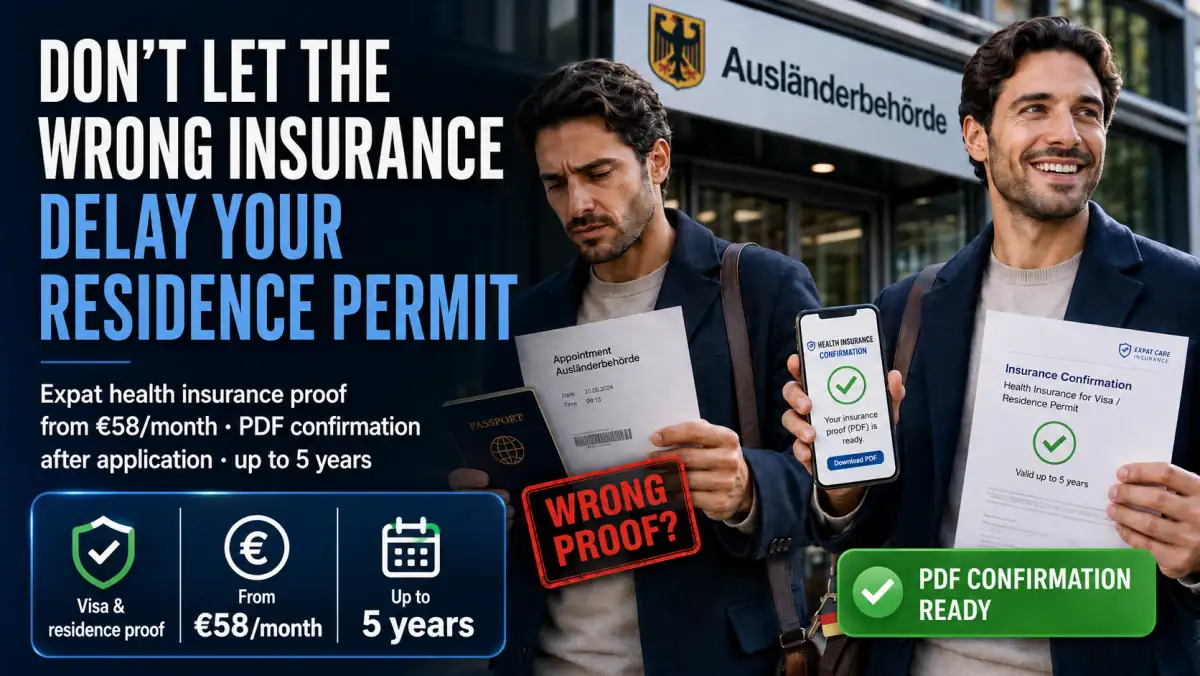
Long-stay health insurance for expats moving to Germany: Ausländerbehörde-recognised cover from €58/month
By Steffan Grund · Reviewed September 8, 2026
“PDF in minutes, the Ausländerbehörde accepted it on the spot.” — R. K. (Berlin), EU Blue Card
Quotes from internal customer feedback, anonymised and shortened.
Plan: pick recognised cover → get bilingual PDF → submit at the Ausländerbehörde.
Popular with expats moving to Germany from — show country list
Pakistan (Islamabad, Karachi, Lahore), India (Delhi, Mumbai, Bengaluru, Hyderabad, Chennai), Bangladesh, Sri Lanka, Nepal, Türkiye, Iran, Iraq, Syria, Lebanon, Egypt, Morocco, Tunisia, Algeria, Nigeria, Ghana, Kenya, Ethiopia, the Philippines, Indonesia, Vietnam, Thailand, China, Brazil, Colombia, Mexico, Ukraine, Russia, Kosovo, Serbia, Bosnia, North Macedonia and Albania.
Used since 2009 by applicants worldwide — typically accepted nationwide in Germany by the Ausländerbehörden (incl. LEA Berlin, KVR Munich, Hamburg, Frankfurt, Cologne, Stuttgart, Düsseldorf) and the German embassy network under § 5 AufenthG.
No commitment · monthly cancellation · confirmation by email (typically immediate).
No valid health insurance proof — no residence permit. The German Ausländerbehörde (immigration office) checks your Krankenversicherungsnachweis at every Aufenthaltstitel appointment under § 5 AufenthG. That applies to Blue Card EU holders, freelancers (Aufenthaltserlaubnis zur selbständigen Tätigkeit), skilled workers under the Fachkräfteeinwanderungsgesetz, family reunification spouses, PhD researchers, digital nomads on the job-seeker visa and anyone bridging the gap between arrival and statutory health insurance (GKV) enrolment.
For 6 months to 5 years of cover, the standard private long-term Incoming insurance is Care Expatriate from €58/month (age 13–40, Basic tier) — a HanseMerkur (underwritten by Advigon) product regularly accepted by the Ausländerbehörde, the German embassy network and German HR departments as proof of cover under § 5 AufenthG. For shorter visitor or job-seeker stays up to 24 months, the alternative is Care Economy (visitor bridge up to 2 years).
Below: when GKV is mandatory, when private cover is the only option, how the JAEG salary threshold changes everything for Blue Card hires — and the exact wording your Ausländerbehörde caseworker expects to see on the certificate.
Editor's note: based on internal Care Concept placement records (2009–2025, 10,000+ policies), the two most common mistakes we see at the Ausländerbehörde counter are an insurer not recognised under § 5 AufenthG and a policy duration that ends before the requested permit period. Both are avoidable — and the checklist, price tables and situation matrix further down show exactly which certificate wording, policy length and tariff route keep the appointment from stalling. Last reviewed by Steffan Grund on September 8, 2026.
Long-Stay Coverage
Care Expatriate by HanseMerkur Versicherungsgruppe / Advigon
Residence Documents
Proof for visa or immigration authority documents
Fast Confirmation
PDF confirmation available after successful application
Indicative: around €1,000 in lost gross weekly wages at the German median per week of residence-permit delay (source: Destatis median earnings 2024) — Care Expatriate premium for the same week: about €14.
What is expat health insurance in Germany?
Quick answer: Expat health insurance in Germany is any health cover — statutory (GKV), substitutive private (PKV) or short-term private Incoming insurance — that the Ausländerbehörde recognises under § 5 AufenthG as proof of cover for issuing or extending a residence permit (Aufenthaltstitel), EU Blue Card, freelancer permit or family reunification visa.
In practice, three families of products are used by foreigners moving to Germany. First, statutory health insurance (GKV) via a Krankenkasse — Techniker Krankenkasse (TK), AOK, Barmer and DAK-Gesundheit are the funds most English-speaking expats join, and "Krankenkasse" simply translates to "sickness fund" in English — mandatory for employees earning below the JAEG ceiling (€77,400/year in 2026, per GKV-Spitzenverband). Second, substitutive private health insurance (PKV) — also called private medical insurance Germany — the long-term private alternative for high earners, civil servants and the self-employed who meet the underwriting criteria. Third, private Incoming insurance — short-to-medium-term cover (typically 3–60 months) designed for newcomers, recognised by the immigration office as a residence-permit-compliant health plan and usually the fastest non-EU health insurance Germany route while you wait for your first GKV payroll, KSK approval or PKV underwriting decision. International medical insurance Germany products sold from abroad are not automatically accepted — § 5 AufenthG asks for cover comparable to German cover. See the official guidance from Make it in Germany — the official Federal Government portal and the Federal Foreign Office visa service.
Over 10,000 policies issued · Since 2009
Need a recognised expat insurance certificate today?
What expats moving to Germany worry about — and how each problem is solved
Quick answer: Four pain points repeat at most Bürgeramt appointments: missing insurance proof for the residence permit, the GKV-versus-PKV decision for freelancers and Blue Card hires, the gap between arrival and the first payroll, and how to insure spouse plus children under family reunification. Each one has a clean answer below — usually Care Expatriate from €58/month for the long stay, Care Economy for the shorter visitor bridge.
Avoid the mistakes that can delay your application
Visitor insurance may be too short
For multi-month or multi-year stays, Care Expatriate can be a better fit than short visitor coverage.
Statutory or private?
Freelancers, self-employed people and some incoming long-stay cases may need private incoming coverage instead of German statutory insurance.
Residence proof requested?
Care Expatriate can provide PDF confirmation after successful application for visa or immigration documents.
Renewal stress later
A longer coverage term can reduce repeated renewal pressure during projects, residence processes or long stays.
Reality check: what happens without a recognised expat insurance certificate
One wrong insurance choice can cost you money, time and your application deadline
A medical incident can become expensive fast — but the wrong certificate can also delay your visa, enrollment, residence permit or work start.
🏥
€500–€1,500
Emergency doctor visit
One urgent doctor or emergency-room visit can already create a painful bill — before tests, medication or follow-up treatment are added.
🏨
€2,000–€10,000+
Hospital treatment
If observation, surgery, overnight stay or specialist treatment is needed, costs can quickly move from hundreds to thousands of euros.
🧳
Up to 5 years
Short visitor cover may be too weak
For long stays, freelance work or residence documents, short visitor insurance may be too short or not the right proof.
- Wrong or incomplete proof can delay your visa, enrollment or authority process.
- Cheap home-country policies may miss the exact coverage, dates or repatriation wording required.
- The cheapest policy can become expensive if it is the wrong proof for your situation.
Before you apply, check: coverage amount, validity dates, destination area and repatriation cover.
Anmeldung, residence-permit slot, payroll cut-off — why timing matters
Why act before your residence documents are due
Long-stay proof can become urgent during visa, residence permit, project or relocation steps. Short visitor cover may not be enough.
Long stay, different proof
Care Expatriate can fit longer incoming stays up to 5 years, depending on age and selected plan.
Residence documents need clarity
Your proof should match destination, coverage period and long-stay purpose.
Do not wait for renewal stress
Preparing longer coverage early can reduce repeated extension pressure.
Private or statutory?
Freelancers, self-employed people and employees on assignment without German statutory insurance may need a different route than employees.
Get your Care Expatriate certificate in 3 steps
About 10 minutes online. Bilingual PDF by email. Recognised at the Ausländerbehörde and by German HR for the residence permit.
Long-term stay covered in 3 steps
Care Expatriate can cover longer incoming stays up to 5 years, depending on age and selected plan.
-
Choose your plan
Care Expatriate for expats, freelancers, self-employed people, employees on assignment without German statutory insurance, or seniors up to entry age 74.
-
Complete the application
Enter passport, destination, stay details and requested coverage period online. Additional questions may apply depending on the plan.
-
Submit your proof
Receive PDF confirmation after successful application and submit it to the embassy, consulate or immigration authority if requested.
What expats say about Care Expatriate for the German residence permit appointment
“My biggest worry was that the embassy wouldn't accept the insurance.
The proof was accepted immediately — no questions asked.
That saved me a lot of stress.”

Georges
Cameroon
“I needed proof of insurance urgently for my visa appointment.
The confirmation arrived within minutes by email.
Everything worked first time at the embassy.”

Olga
Russia
“Found the best solution and best service for health insurance for foreign visitors and guests in Germany.
Fast, simple and affordable.
Highly recommended!”

Michael
Germany
“The online sign-up was done in just a few minutes.
When I actually had to see a doctor, the billing went smoothly.
I was really covered — not just on paper.”

Yunhee
Australia
Now choose your plan
Recommended expat health insurance in Germany — by length of stay
Care Expatriate
from only €58.00 / month (coverage up to 5 years)
For foreign nationals with longer stays: expats, self-employed professionals, freelancers, employees on assignment without German statutory insurance, retirees & seniors up to age 74
- Proof of insurance for visas & immigration authorities quickly available (PDF)
- Coverage up to 5 years – less renewal stress
- Doctor, hospital, prescription medication & dental treatment coverage
- For longer stays in Germany, Austria, the EU/Schengen Area, Liechtenstein or Switzerland
- Suitable for expats, self-employed professionals, freelancers, employees on assignment without German statutory insurance, retirees & seniors
- More planning security for residence permits, projects or jobs
- 24/7 assistance + digital insurance card
- Age-based rates: from €58/month ages 13–40 · from €68 ages 41–60 · from €246 ages 61–74
- Coverage term: 3 months to 5 years · entry age 0–74
- Reputable insurance carrier
Why Care Expatriate?
For foreign nationals with longer stays who need solid health insurance and proof of coverage for authorities — suitable for expats, freelancers, self-employed professionals, employees on assignment without German statutory insurance, retirees & seniors up to age 74.
Why a 5-year coverage term?
More planning security: less renewal stress and a lower risk of a coverage gap if your stay lasts longer.
- 🏛️ HanseMerkur Insurance Group Hamburg – Advigon Insurance AG
- 📄 Instant proof of insurance for visas & immigration authorities (PDF)
- 🔒 Doctor, clinic, dental treatment & repatriation coverage
- 🏷️ From €58 / month · coverage up to 5 years
→ Complete the application, receive your instant PDF, submit your proof
Care Economy
from only €30.00 / 30 days (coverage up to 2 years)
For guests, tourists, family visits, job seekers & the German Opportunity Card
- Proof of insurance for visas & immigration authorities within minutes
- Affordable coverage from €1.00 per day
- Doctor, hospital & dental emergency coverage
- Suitable for Schengen visas, the Opportunity Card & family visits
- Flexible coverage from 1 day up to 2 years
- Coverage in Germany, the EU & the Schengen Area
- 24/7 assistance + digital insurance card
- Age-based rates: from €1.00/day up to age 64 · from €2.95/day for ages 65–74
- Coverage term: 1 day to 2 years · entry age 0–74
- Reputable insurance carrier
Why Care Economy?
For anyone who needs fast, affordable proof of health insurance — ideal for guests, visitors, tourists, family visits or job seekers, with doctor/clinic coverage subject to the policy terms and benefits.
Why a 2-year coverage term?
More flexibility when plans are uncertain: if your visa, trip or stay is extended, you avoid last-minute renewal stress and reduce the risk of a coverage gap.
- 🏛️ HanseMerkur Insurance Group Hamburg – Advigon Insurance AG
- 📄 Instant proof of insurance for visas & immigration authorities (PDF)
- 🔒 Doctor, clinic, dental emergency & repatriation coverage
- 🏷️ From €30 / 30 days · up to 2 years possible
→ Complete the application, receive your instant PDF, submit your proof
Care Visa Protect
from only €0.85 / day (1–92 days possible)
For Schengen visas, tourists, family visits & business travel
- Proof of insurance for visas & immigration authorities quickly available (PDF)
- Meets Schengen visa insurance requirements
- Affordable coverage from €0.85/day (minimum premium applies)
- Doctor, hospital, prescription medication & dental emergency coverage
- For Germany, Austria, the EU/Schengen Area, Liechtenstein or Switzerland
- Ideal for short stays, family visits, tourists & business travelers
- Multiple-visa option: several trips up to a total of 92 days/year
- Must be purchased before entry
- Age-based rates: from €0.85/day up to age 64 · from €2.60/day for ages 65–74
- Coverage term: 1–92 days · entry age 0–74
Why Care Visa Protect?
For foreign visitors with a Schengen visa who need fast, affordable proof of insurance for an embassy, visa office or immigration authority — suitable for tourists, family visits and short business trips.
Why a 92-day coverage term?
Ideal for typical short stays and Schengen trips: enough coverage for a visit, vacation or business trip — without buying long-term insurance.
- 🏛️ HanseMerkur Travel Insurance AG, Hamburg
- 📄 Instant proof of insurance for visas & immigration authorities (PDF)
- 🔒 Doctor, clinic, dental emergency & repatriation coverage
- 🏷️ From €0.85 / day · coverage up to 92 days
→ Complete the application, receive your instant PDF, submit your proof
Care Expatriate — all prices by age band & tier
Quick answer: Care Expatriate is priced per age band (0–12, 13–40, 41–60, 61–74) and tier (Basic / Comfort / Premium). The entry premium is €58/month at age 13–40 on the Basic tier, with worldwide cover including the home country.
| Care Expatriateworldwide without USA, Canada and Mexico |
Basic
|
BestsellerComfort
|
Premium
|
|||
|---|---|---|---|---|---|---|
|
Deductible / yr
150,–
|
Deductible / yr
150,–
|
Deductible / yr
500,–
|
Deductible / yr
0,–
|
Deductible / yr
500,–
|
Deductible / yr
1.000,–
|
|
| Entry age:0–12 (€ / month) | 64,– | 104,– | 81,– | 191,– | 149,– | 117,– |
| Entry age:13–40 (€ / month) | 58,– | 84,– | 63,– | 181,– | 141,– | 109,– |
| Entry age:41–60 (€ / month) | 68,– | 103,– | 77,– | 256,– | 201,– | 156,– |
| Entry age:61–74 (€ / month) | 246,– | 322,– | 248,– | 432,– | 336,– | 263,– |
All prices per month/person in euros. Deductible applies per insurance year. As of 2026.
Care Economy — visitor & job-seeker bridge prices (up to 2 years)
Quick answer: Care Economy is the short-to-medium-stay bridge cover for visitors, job-seekers (§ 20 AufenthG) and the gap between arrival and the first GKV payroll. Prices are per day, age band (0–64 / 65–74) and chosen duration block (up to 90 days, 91–180, 181–365, 366–730).
| Care Economy Duration |
Bestsellerup to 64
|
up to 64
|
Bestseller65+
|
65+
|
|---|---|---|---|---|
| no deductible | with deductible | no deductible | with deductible | |
| up to 90 days | €1.18/day | €1.00/day | €3.48/day | €2.95/day |
| 91–180 days | €1.59/day | €1.35/day | €4.37/day | €3.70/day |
| 181–365 days | €2.30/day | €1.95/day | €5.84/day | €4.95/day |
| 366–730 days | €2.83/day | €2.40/day | €9.32/day | €7.90/day |
All prices per day/person in euros. Minimum premium €10 per person and term. Deductible is the share you pay yourself. Entry age 0–74. As of 2026.
Care Visa Protect — Schengen short-stay prices (up to 92 days)
Quick answer: For Schengen C-visa visitors who do not need a residence permit, Care Visa Protect is the lowest-cost compliant option: from €0.85/day with a €50,000 benefit ceiling — well above the Schengen minimum of €30,000 — and no deductible. It is Schengen-compliant medical cover, not the generic travel insurance Germany sells to tourists: the Ausländerbehörde and German embassies specifically require the medical-cover variant for the visa file. Long-stay expats applying for a residence permit should use Care Expatriate above, not this tariff.
| Care Visa Protect | Daily premium | Multiple Visa (annual contract) |
|---|---|---|
| up to age 64 | €0.85/day | €110/year |
| 65 – 74 years | €2.60/day | €215/year |
Prices per person. Minimum premium €8.50 per trip. Maximum benefit €50,000 (well above the Schengen minimum of €30,000). Deductible €0. Must be purchased before travel. As of 2026.
Expat health insurance in Germany by nationality & passport
Quick answer: Recognition of foreign cover by the Ausländerbehörde depends almost entirely on the visa pathway, not the passport — but the typical visa pathway does vary by nationality. The matrix below maps the most common cases to the recommended German-compliant tariff.
| Nationality / passport | Typical visa pathway | Recommended tariff |
|---|---|---|
| USA / Canada / UK / Australia / NZ / Japan / Korea / Israel | Visa-free entry, permit applied for in Germany (§ 41 AufenthV) | Care Expatriate |
| India / China / Vietnam / Philippines / Indonesia | National D-visa from German embassy + residence permit | Care Expatriate |
| Turkey / Morocco / Egypt / Tunisia | National D-visa for work, study or family reunification | Care Expatriate |
| EU / EEA / Switzerland | Freedom of movement (EU FreizügG); EHIC bridges short stays | GKV via employer or Care Expatriate |
| Western Balkans (Serbia, Kosovo, North Macedonia, Albania, Bosnia, Montenegro) | Western Balkans regulation (§ 26 BeschV) — work visa with employer offer | Care Expatriate |
| Schengen-visa visitors (any nationality, ≤ 90 days) | C-visa, no residence permit; needs Schengen-compliant cover | Care Visa Protect |
Recognition is decided case by case by the Ausländerbehörde — this matrix reflects the most frequent patterns we have observed since 2009 placing Care Concept covers for expats. Always verify against your specific visa decision letter.
Which expat insurance fits which situation?
Quick answer: Use this matrix to map your status — Blue Card hire, freelancer, self-employed, family reunification, job seeker or visitor — to the tariff and entry price most commonly recommended for that case.
| Your situation | Recommended tariff | From |
|---|---|---|
| EU Blue Card / skilled-worker hire, salary above JAEG | Care Expatriate (then optionally PKV) | from €58/month (up to 5 years) |
| Freelancer / self-employed (Aufenthaltserlaubnis nach § 21 AufenthG) | Care Expatriate — freelancer guide | from €58/month (up to 5 years) |
| Bridge between arrival and first GKV payroll | Care Economy (30 days – 2 years) | from €30 / 30 days (up to 2 years) |
| Spouse / child under family reunification visa | Care Expatriate per family member | from €58/month (up to 5 years) |
| Job-seeker visa (§ 20 AufenthG) up to 6 months | Care Economy job-seeker bridge | from €30 / 30 days (up to 2 years) |
| Long-term stay beyond 5 years | Long-term private cover — guide | from €58/month (up to 5 years) |
Not sure which fits? Try the 30-second tariff finder.
Expat insurance topics: deep guides by status and life event
Freelancers & self-employed expats
- → Health insurance for foreign freelancers in Germany — recognised proofs, Steuernummer interplay, KSK rules
- → Health insurance for the self-employed (§ 21 AufenthG) — Aufenthaltserlaubnis zur selbständigen Tätigkeit
- → Common pitfalls when self-employed expats pick the wrong cover
Blue Card, employed expats & the GKV/PKV decision
- → Health insurance for foreign employees in Germany — statutory enrolment, employer share, JAEG threshold
- → Statutory or private cover? How the German healthcare system decides
- → Health insurance during job search in Germany (§ 20 AufenthG)
Long-term stays, family & transitions
- → Long-term health insurance for foreigners in Germany — what comes after the 5-year Care Expatriate cap
- → Family & parent reunification health insurance Germany
- → Foreign retirees in Germany — long-term cover after retirement
Authority paperwork & the residence-permit appointment
- → Residence over 90 days — which insurance the Ausländerbehörde typically requires
- → What German authorities accept as Krankenversicherungsnachweis
- → What German HR requires as insurance proof for payroll
- → FAQ — health insurance for foreigners in Germany (full overview)
- → Krankenkasse comparison — TK vs DAK vs Barmer vs AOK
Artists, writers & freelancers: the Künstlersozialkasse (KSK)
Quick answer: The KSK is a German social-insurance hub that pays roughly 50% of the statutory health-insurance and pension contributions for self-employed artists, journalists, designers and writers — effectively turning independent creatives into employer-subsidised members of GKV.
In practice, most expats moving to Germany cannot use KSK in their first year: KSK requires evidence of a genuine, ongoing creative self-employment in Germany (typically client invoices issued from a German Steuernummer) before it approves membership. Until that evidence accrues — and through the months-long KSK review — Care Expatriate (Incoming insurance) from from €58/month (up to 5 years) is the standard bridge cover that the Ausländerbehörde accepts under § 5 AufenthG for the freelancer permit (§ 21 AufenthG).
Once KSK membership is granted, you move to a German Krankenkasse (e.g. TK, AOK, Barmer, DAK-Gesundheit), KSK pays the employer share, and Care Expatriate can be cancelled with the standard 5 € handling fee against the GKV Mitgliedsbescheinigung. Source: Künstlersozialkasse.
Glossary — expat health insurance terms in Germany
Quick answer: The terms below appear in most Ausländerbehörde appointments and most HR onboardings for foreigners. Mastering them shortens the paperwork from days to one afternoon.
Expat health insurance in Germany sits across three layers. Statutory cover (GKV) is delivered by German sickness funds (Krankenkassen) such as Techniker Krankenkasse (TK), AOK, Barmer and DAK-Gesundheit — these are the funds Blue Card and most employed expats use from their first payroll. Short-to-medium-term private cover (Incoming insurance) for arrivals, freelancers and family-reunion spouses is offered by insurers and brokers including Care Concept (Care Expatriate, Care Economy), HanseMerkur, Mawista, DR-WALTER, ALC Health, Ottonova, Cigna Global, Allianz Care and AXA Global Healthcare. Long-term substitutive PKV is a separate, medically underwritten product offered by carriers such as Debeka, Signal Iduna, Allianz Krankenversicherung, Gothaer, Hallesche, Barmenia and Continentale — relevant only once income, residence status and underwriting align. Most expats start with Incoming cover and only move to PKV later, if at all.
- Krankenversicherungsnachweis
- Proof of health insurance, in German, that the Ausländerbehörde requires for every residence permit (Aufenthaltstitel) decision under § 5 AufenthG.
- Aufenthaltstitel
- German residence title (visa, residence permit, EU Blue Card, settlement permit) issued by the Ausländerbehörde under the Aufenthaltsgesetz (AufenthG).
- JAEG (Jahresarbeitsentgeltgrenze)
- Annual income threshold above which employees may opt out of statutory health insurance (GKV) into private insurance — €77,400/year in 2026 per GKV-Spitzenverband.
- Incoming insurance
- Private health insurance product designed for non-residents staying temporarily in Germany (up to 5 years). Recognised by the Ausländerbehörde. Not the same as substitutive PKV.
- GKV (gesetzliche Krankenversicherung)
- Statutory health insurance system under SGB V. Mandatory for employees with gross salary below the JAEG threshold.
- PKV (private Krankenvollversicherung)
- Substitutive private health insurance — the long-term alternative to GKV for high-income employees, civil servants and the self-employed who meet the underwriting criteria.
- Krankenkasse
- German statutory sickness fund (e.g. TK, AOK, Barmer, DAK-Gesundheit) operating under SGB V.
- International expat insurance providers (Incoming category)
- Incoming insurance for expats in Germany — short of substitutive PKV — is offered by several insurers and brokers. Beyond the Care Concept tariff we place (Care Expatriate), examples include HanseMerkur, Mawista, DR-WALTER, ALC Health, Ottonova, Cigna Global, Allianz Care and AXA Global Healthcare. These products bridge the period before statutory GKV (e.g. before the first payroll on a Blue Card) or replace it where GKV is not available (most freelancers, family-reunion spouses).
- Substitutive German PKV providers (long-term private)
- Substitutive PKV (private Krankenvollversicherung) is the long-term private alternative to GKV for high-income employees above the JAEG, civil servants and most self-employed. Examples of insurers active in this segment include Debeka, Signal Iduna, Allianz Krankenversicherung, Gothaer, Hallesche, Barmenia, HanseMerkur and Continentale. PKV is medically underwritten, age-based and very different from Incoming cover — most newly arrived expats start with Incoming insurance (e.g. Care Expatriate) and only consider PKV once income, residence status and underwriting align.
How long should the health insurance run?
Quick answer: Usually for as long as the stay is planned to last — and not shorter. The premium is set by the entry age at the start of the contract and stays in that age band for the whole term. Anyone who extends later typically signs a new contract at the age they are by then.
| Term | Premium/month | Total | Renewals needed | Pre-existing-condition gap |
|---|---|---|---|---|
| 12 months | €58 | €696 | 4 | possible (2×) |
| 24 months | €58 | €1,392 | 2 | possible (1×) |
| 60 months | €58 | €3,480 | 0 | none |
Is a 41st birthday coming up?
In the 13–40 age band the Basic premium is €58/month; in the 41–60 band it is €68/month (example values). The difference is around €10 a month — roughly €600 over 60 months. What counts is the age at the start of the contract, not the age during the term. Concretely: someone who chooses a 60-month term at 40 pays the 13–40 band for five years, rather than the 41–60 band from their 41st birthday onwards.
When the renewal falls due
A policy with a twelve-month term typically expires at close to the point the residence permit (Aufenthaltstitel) also needs extending. Both then fall in the same weeks: new contract, new proof of cover, new appointment at the foreigners' authority (Ausländerbehörde) — often under time pressure. A longer term decouples the two dates. There is also the practical effort: every renewal means passport details, proof of address and personal information again — usually gathered by relatives in Germany while the insured person is still abroad.
What is different at renewal
Conditions that first arise during a running contract are, as a rule, covered within that contract. In a contract taken out later they typically count as a pre-existing condition — and pre-existing conditions are usually excluded in incoming tariffs. The older the insured person, the more likely it is that a diagnosis falls between two contracts, and that diagnosis then usually counts as pre-existing in the follow-up contract. A continuous term avoids that gap.
A gap can also open up between two contracts — days without cover, which may become visible when the residence permit is next extended. A continuous term avoids that.
A fixed term also means planning certainty for the family: the premium is set for the whole duration, with no annual recalculation.
For context: Care Expatriate can be taken out up to the age of 74.
Monthly or a single payment?
Quick answer: Both are possible, and the price is the same — there is no discount for paying in one go. The difference lies in the risk: if a direct debit goes unpaid, that can affect the insurance cover — and the residence permit rests on that cover. With a single payment the cover no longer depends on an ongoing bank debit. That matters above all where the premiums are paid by relatives in Germany: a job change, a change of bank or one tight month then has no bearing on the insured person's residence status.
Where the premium is transferred from abroad, one payment replaces up to sixty individual transfers — each with its own bank charges and exchange rate.
What happens on an early return?
If the stay ends earlier than planned, the contract can be cancelled in writing. The overpaid premium is, as a rule, refunded minus a €5 processing fee (source: Care Concept FAQ). So someone who pays 60 months in advance and returns after two years gets the premium for the unused months back — the financial risk of paying in one go is therefore €5, not the remaining balance.
And if the visa is not granted?
If the entry visa is not granted, or entry does not take place for other reasons, the application can be cancelled in writing before the insurance cover begins. Premiums already paid are, as a rule, refunded minus a €5 processing fee (source: Care Concept FAQ).
Frequently asked questions about expat health insurance in Germany
Frequently Asked Questions
Is Care Expatriate accepted by the German Ausländerbehörde for the residence permit?
Yes — Care Expatriate is regularly recognised under § 5 AufenthG by German immigration offices as proof of health insurance for the Aufenthaltstitel, EU Blue Card, freelancer permit (§ 21 AufenthG) and family reunification visa.
Care Expatriate or statutory cover — which one for a Blue Card hire?
If your gross salary stays below the JAEG threshold (€77,400/year in 2026), you are GKV-mandatory and your employer enrols you in a statutory fund. Above the threshold, you can stay in GKV or opt out into private insurance. Many Blue Card holders use Care Expatriate as a bridge between arrival and the first statutory payroll, then switch once HR confirms the start date.
What is the maximum duration for Care Expatriate?
Up to 60 months (5 years) per policy. After that, expats typically transition to long-term substitutive PKV (private Krankenvollversicherung) or stay in GKV through their employer, depending on income and status.
Does Care Expatriate cover trips back to my home country?
Expats pay from €58/month (13–40) via Care Expatriate; SB 150 €, worldwide including home country. Yes. Cover is worldwide and explicitly includes the home country (30, 45 or 90 days per year depending on the tier you choose) — useful for expats who fly home regularly for family or business.
Can a freelancer or self-employed expat use Care Expatriate for the residence permit?
Yes — see the dedicated guide on health insurance for foreign freelancers in Germany for the exact paperwork the Ausländerbehörde expects.
How do I switch from Care Expatriate to GKV once my employer enrols me?
Per AVB, unused premium is refunded and a one-off 5 € handling fee applies — there is no minimum-term penalty. Care Expatriate is a monthly policy. Once your statutory cover begins, send a written cancellation together with the GKV membership certificate (Mitgliedsbescheinigung) and the desired end date.
Is family reunification (spouse and children) covered under one policy?
Expats pay from €58/month (13–40) via Care Expatriate; SB 150 €, worldwide including home country. No — each family member needs an individual Care Expatriate policy, but they can be issued together with synchronised start dates so the Ausländerbehörde receives one consolidated submission for the family reunification visa.
How much is health insurance in Germany for foreigners?
Statutory health insurance (GKV / public health insurance Germany) costs roughly 14. Health insurance cost in Germany depends on the route. 6% of gross salary plus the additional contribution, split with the employer. Private health insurance Germany (substitutive PKV) is priced individually by age, health and tier. Private Incoming insurance for newcomers — German health insurance for foreigners during the first months or years — starts from €58/month with Care Expatriate (age 13–40, Basic), or from €0. 85/day for short Schengen visits with Care Visa Protect.
How to get health insurance in Germany as a foreigner before the residence permit appointment?
(1) Pick the right tariff for your visa: Care Expatriate for long-stay residence permit, Care Economy for visitor/job-seeker bridge, Care Visa Protect for Schengen C-visa visits. Three steps. (2) Apply online and download the bilingual certificate as residence-permit proof and visa proof. (3) Bring the certificate to the Ausländerbehörde or German embassy as your Krankenversicherungsnachweis under § 5 AufenthG. Freelancer health insurance Germany and Blue Card cases use the same flow — only the supporting paperwork differs.
How much is private health insurance in Germany for expats?
Expats pay from €58/month (13–40) via Care Expatriate; SB 150 €, worldwide including home country. Two very different price logics. Private Incoming insurance — what most expats use during the first months or years — starts at €58/month with Care Expatriate (age 13–40, Basic tier) and scales upward with age band and tier; the upper age bands (61–74, Premium tier) reach several hundred €/month — exact figures per the Care Expatriate price table further up this page. Substitutive German PKV (private Krankenvollversicherung) is medically underwritten and age-based; new entrants typically see several hundred €/month depending on age, health and tier (individual quote required), and the JAEG income threshold of €77,400/year (2026) must usually be met to opt out of GKV. Most expats start with Care Expatriate and only consider substitutive PKV once income, residence status and underwriting align — final acceptance and pricing depend on the carrier and the individual case (Einzelfallprüfung).
Medical insurance Germany — public vs private, what is the difference?
Public / statutory: GKV (gesetzliche Krankenversicherung) via Krankenkassen such as Techniker Krankenkasse (TK), AOK, Barmer and DAK-Gesundheit — mandatory for employees below the JAEG (€77,400/year in 2026), priced at 14. Three categories. 6% of gross salary plus the fund's Zusatzbeitrag. Substitutive private: long-term German PKV from insurers such as Debeka, Signal Iduna, Allianz Krankenversicherung, Gothaer or Hallesche — for high-income employees, civil servants and most self-employed. Incoming private: short- to mid-term cover for newcomers (Care Expatriate, Cigna Global, Allianz Care, AXA Global Healthcare, Mawista) — used until GKV or substitutive PKV is appropriate. Pick the route that matches your stage; the brand inside each category is a free choice.
Health insurance Germany for non-EU citizens — what does the Ausländerbehörde accept?
The Ausländerbehörde verifies one document under § 5 AufenthG: the Krankenversicherungsnachweis. For Blue Card and skilled-worker employees on a German payroll, this is the GKV membership certificate (Mitgliedsbescheinigung). For freelancers (§ 21 AufenthG), Chancenkarte job seekers, family-reunion spouses and most other non-employees, this is typically Care Expatriate (Incoming insurance, up to 5 years) or Care Economy for shorter bridges. Travel insurance from the home country is generally not accepted for the residence permit decision — it does not include the German-style hospitalisation clause the Ausländerbehörde looks for.
German PKV (private Krankenversicherung) vs Incoming-Versicherung for expats — which is right?
Expats pay from €58/month (13–40) via Care Expatriate; SB 150 €, worldwide including home country. Different products for different stages. Incoming-Versicherung (Care Expatriate and peer category products from Cigna Global, Allianz Care, AXA Global Healthcare, Mawista, DR-WALTER) is monthly, no medical underwriting at entry, runs up to 5 years and is built for the early expat phase (Blue Card before payroll, freelancer permit, family reunion, Chancenkarte). Substitutive German PKV (Debeka, Signal Iduna, Allianz Krankenversicherung, Gothaer, Hallesche, Barmenia, HanseMerkur, Continentale) is the long-term private alternative to GKV — medically underwritten, age-based, lifetime contract, only available to high-income employees above the JAEG, civil servants and most self-employed. Most newcomers start with Incoming and only consider substitutive PKV once income, residence status and underwriting align.
Is travel insurance from my home country enough for the German residence permit?
Expats pay from €58/month (13–40) via Care Expatriate; SB 150 €, worldwide including home country. Generally no. Most home-country travel insurance policies are not accepted as a Krankenversicherungsnachweis under § 5 AufenthG because they exclude long inpatient stays, cap benefits below the German standard, or are not enforceable through a German claims address. For the residence permit (Aufenthaltstitel), EU Blue Card, freelancer permit (§ 21 AufenthG) and family reunification visa the Ausländerbehörde typically expects German-style Incoming insurance with unlimited inpatient cover and a German correspondence address — Care Expatriate from €58/month is the standard fit. Recognition is decided case by case (Einzelfallprüfung) — keine Rechtsberatung.
How much does freelancer health insurance cost in Germany?
(2) Künstlersozialkasse (KSK) — for artists, writers and journalists — pays roughly half the GKV contribution, so net cost is typically around 7. Three price logics depending on the route. (1) Private Incoming insurance — the fastest route for new freelancers on a § 21 AufenthG residence permit — starts at €58/month with Care Expatriate (age 13–40, Basic tier) and scales by age band and tier. 3% of taxable income plus the chosen fund's Zusatzbeitrag and 1. 7–2. 0% Pflegeversicherung. (3) Freiwillige GKV (voluntary statutory) — open to most self-employed — is roughly 14. 6% of taxable income (capped at the JAEG ceiling, €77,400/year in 2026) plus Zusatzbeitrag and Pflegeversicherung; final figures depend on income proof and the chosen Krankenkasse.
How do Care Expatriate, GKV and substitutive PKV actually compare for an expat in Germany?
Expats pay from €58/month (13–40) via Care Expatriate; SB 150 €, worldwide including home country. A useful expat health insurance Germany comparison sorts the market into three buckets. The first is Incoming insurance for Germany expats — Care Expatriate Germany sits in the international health insurance Germany category and is the fastest residence-permit-compliant route, recognised by the Ausländerbehörde as a Krankenversicherungsnachweis for the Aufenthaltstitel and as Aufenthaltserlaubnis health proof under § 5 AufenthG. The second is the statutory sickness fund Germany cover, sometimes called the Krankenkasse for foreigners — Techniker Krankenkasse, AOK, Barmer and DAK-Gesundheit — which is mandatory for employees earning below the Versicherungspflichtgrenze in 2026, the JAEG line of €77,400 per year (the same threshold often written JAEG 77400 2026). The third is substitutive PKV, the long-term private alternative for high earners above that line. The classic GKV vs PKV Germany debate, including the question of TK vs private insurance for a Germany expat, only opens once the residence permit and the first German payroll are in place. Until then, private health insurance for Germany expats is normally Care Expatriate.
Which insurance proof do the Blue Card, Niederlassungserlaubnis, Chancenkarte and family-reunification routes each ask for?
For the Blue Card, health insurance in Germany defaults to the GKV Mitgliedsbescheinigung once payroll starts, and Care Expatriate Germany is the bridge before day 1. Each route uses a slightly different proof, but the menu is short. For the Niederlassungserlaubnis — the German settlement permit — the Ausländerbehörde wants a continuous Krankenversicherungsnachweis history, so either GKV membership or Care Expatriate counts as Niederlassungserlaubnis insurance. The Chancenkarte opportunity card defaults to Care Economy for the twelve-month job-search window, so whether you search for 'Chancenkarte opportunity card insurance' or the more specific 'Chancenkarte opportunity card health insurance', both resolve to the same Care Economy certificate. For family reunification, the spouse uses the free Familienversicherung in the GKV — the spouse-Germany pathway under § 10 SGB V, which gives Familienversicherung as free coverage for the spouse and children — once the resident spouse is on payroll, and Care Expatriate covers the months before. Health insurance for digital nomads in Germany follows the same logic: Care Expatriate during the residence-permit phase, then GKV or PKV once status stabilises.
What are the three freelancer routes — KSK, voluntary GKV and Incoming insurance — and how does each one cost out?
The second is voluntary GKV (freiwillige gesetzliche Krankenversicherung), open to most other self-employed expats at about 14. Freelancer Krankenversicherung for the Selbständige in Germany splits three ways. The first is the Künstlersozialkasse: freelancer Krankenversicherung via the KSK — in English, the KSK (Künstlersozialkasse) freelancer health insurance scheme — is open to artists, writers and journalists, and pays roughly half the GKV rate. 6% of taxable income plus the fund's Zusatzbeitrag, capped at the Versicherungspflichtgrenze in 2026 — the same JAEG line of €77,400 per year (often written JAEG 77400 2026). The third is private Incoming insurance: Care Expatriate from €58/month is the fastest residence-permit-compliant route for new § 21 AufenthG freelancers, and the recognised Aufenthaltserlaubnis health proof.
How does the Bürgeramt-Anmeldung paperwork chain work, and does the city you live in matter?
The German hospital cost without insurance averages in the high three figures per day (Statistisches Bundesamt, 2024) — exactly why caseworkers verify proof before issuing the permit. The first physical document check after you arrive is at the Bürgeramt: registering your German address is what landlords and the Ausländerbehörde caseworker mean when they ask for Bürgeramt-Anmeldung insurance proof. The Bürgeramt issues the Anmeldebestätigung once registration is done, and that Anmeldebestätigung — combined with your insurance proof from the Bürgeramt visit — is what the caseworker pairs with the Krankenversicherungsnachweis for your Aufenthaltstitel. On the city question, expat insurance in Berlin, Munich, Hamburg and Frankfurt — the four largest German expat hubs — runs under identical Ausländerbehörde rules, so the same Care Expatriate certificate works in Berlin (at the LEA), Munich (at the KVR), Hamburg (at the Einwohner-Zentralamt) and Frankfurt. Why the strict check?
Over 10,000 policies issued · Since 2009
Ready for the Ausländerbehörde appointment? Pick your expat plan.
Part of: Health insurance for foreigners in Germany — the umbrella hub for every visa, student, employee and retiree route.